
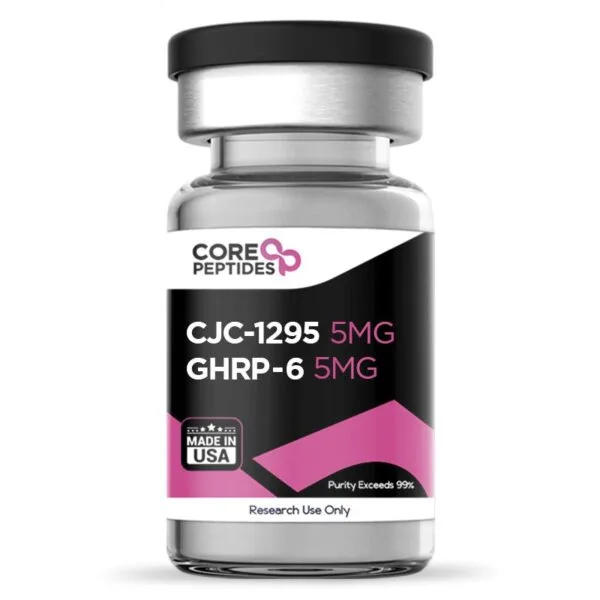
CJC-1295 & GHRP-6 Blend (10mg)
Original price was: $75.00.$69.00Current price is: $69.00.
Size: 10mg
Contents: CJC-1295 NO DAC (5mg) & GHRP-6 (5mg)
Form: Lyophilized powder
Purity: >99%
SKU: P-CJCGHR6-10
FREE Shipping on $200+ orders
| Quantity | Discount | Price |
|---|---|---|
| 5 – 8 | 5% | $65.55 |
| 9 + | 10% | $62.10 |
CJC-1295 & GHRP-6 Peptide Blend
Research indicates that peptides CJC-1295 and GHRP-6 may exert potential action on growth hormone release. When presented as a blend, they may possibly induce synergistic action, stimulating an organism’s synthesis and secretion of growth hormones. This peptide blend may possibly help repair mild injuries associated with muscles and surrounding ligaments.
GHRP-6 peptide is a synthetic six amino acid peptide analog of ghrelin, a naturally occurring peptide that is considered by scientists to stimulate the secretion of growth hormones and help maintain their concentrations.(1) To do so, researchers hypothesize that it may activate what is known as the growth hormone secretagogue receptor (GHS-R1a). In terms of structure, GHRP-6 does not appear to share any homology with ghrelin despite its affinity to the receptors, but instead it appears to be an opioid analog of the peptide Met-enkephalin. Yet, researchers suggest it lacks the opioid activity which is typically associated with these enkephalins. Thus, GHRP-6 is a synthetic hexapeptide that researchers have classified in the group of growth hormone secretagogues (GHSs).
CJC-1295, also referred to as tetra-substituted GRF (1-29), is a synthetic peptide analog of the naturally occurring growth hormone-releasing hormone (GHRH), which is believed by researchers to trigger the release of growth hormones.(2) It is essentially equivalent to the shortest chain of amino acids that may potentially attach to the GHRH receptors, which are the first 29 amino acids of GHRH. The key structural distinctions between CJC-1295 and GRF (1-29) are found in four altered amino acids of the original 29 amino acids of GHRH. These modifications involve the 2nd, 8th, 15th, and 27th amino acids, and may potentially enhance the peptide’s resistance to degradation by the enzyme dipeptidyl peptidase-4. Specifically, the modifications include:
- The substitution of L-alanine with D-alanine at the 2nd position which is believed to increase resistance to molecular breakdown.
- Replacing asparagine with glutamine at the 8th position which may potentially reduce asparagine rearrangement and amide hydrolysis.
- The replacement of glycine with alanine at the 15th position which is hypothesized to augment bioactivity.
- Changing methionine with leucine at the 27th position which is posited to inhibit methionine oxidation.
Chemical Makeup(2)(3)
Molecular Formula:
CJC-1295 peptide: C152H252N44O42
GHRP-6 peptide: C46H56N12O6
Molecular Weight:
CJC-1295 peptide: 3367.9 g/mol
GHRP-6 peptide: 873.0 g/mol
Other Known Titles:
- Growth hormone-releasing hexapeptide
- CJC-1295 with DAC
- CJC-1295 without DAC
Both forms of the CJC-1295 peptide essentially exert the same action; however, the addition of DAC (known as the drug affinity complex) appears to change the duration of the action of the peptide. CJC-1295 with DAC may have a longer-lasting action than CJC-1295 without DAC. This could be attributed to the proposed ability of the DAC to attach itself to proteins in the plasma. Specifically, the DAC element involves the connection of a lysine derivative, namely N-epsilon-3-maleimidopropionamide, to the C terminus of CJC-1295. The fusion of this altered amino acid sequence with the DAC element may possibly boost the pharmacokinetics of CJC-1295, prolonging its coexistence with plasma proteins to roughly 8 days, while concurrently preserving a noticeable affinity towards GHRH receptors, akin to the affinity demonstrated by CJC-1295 without DAC.
Research and Clinical Studies
CJC-1295 & GHRP-6 Peptide Blend and Growth Hormone Levels
A clinical trial(4) was conducted in male test subjects aged between 20 and 40. All subjects were divided into two groups; one was presented with a placebo, and the rest received the CJC-1295 peptide. A blood sample was collected from all the subjects before and after peptide presence. Based on these samples, researchers reported that the peptide possibly contributed to a 7.5-fold increase in the subjects’ growth hormone levels compared to the placebo group. The growth hormone levels appeared to increase gradually and remained unchanged one week after the peptide presence.
In another clinical study,(5) the peptide was given in ascending concentrations in a group of test subjects aged between 20 and 60. All subjects were divided into two groups – one was presented with the peptide, while the other with a placebo. After the end of the study, when blood samples were examined, it was noted that there appeared to be concentration-dependent action, up to 10-fold, in the levels of the subjects’ growth hormones. As per Madalina Ionescu, et al., “The marked enhancement of trough GH levels by continuous GHRH stimulation implicates the importance of this effect on increasing IGF-I. Long-acting GHRH preparations may benefit patients with intact pituitary GH secretory capability.” IGF-1 stands for insulin-like growth factor-1. It is considered by researchers to be the main anabolic mediator of growth hormone.
In a clinical study focusing on the GHRP-6 peptide,(6) younger test subjects between 6 and 11 were presented with the peptide. Some were only given the peptide, while the rest were presented with a blend of peptide and arginine (a growth hormone booster). After the completion of the study, it was reported by the researchers that the growth hormone levels appeared to have increased exponentially and in equal concentrations in all subjects, seemingly regardless of the presence of arginine.
CJC-1295 & GHRP-6 Peptide Blend and Hypothyroidism
Hypothyroidism is characterized by low levels of growth hormones in an organism. In a 1997 clinical study,(7) subjects with hypothyroidism were presented with either GHRP-6 peptide, GHRH peptide, or a blend of peptides (such as CJC-1295) and GHRP-6. Post-study, it was reported that subjects presented with the blend exhibited apparently significantly higher levels of growth hormones than the individual peptides alone. The GHRP-6 peptide is considered to be an antagonist of somatostatin, which may be an inhibitor of growth hormone secretion. Due to this, the peptide blend appeared to yield a higher result. As per F R Pimentel-Filho et al., “When GHRP-6 was associated with GHRH, a significant increase in the GH response was observed in these patients, which could suggest a role for somatostatin in this process. Our data suggest that thyroid hormones modulate GH release induced by GHRH and GHRP-6 through different mechanisms. However, additional studies are necessary to elucidate this hypothesis further.”
CJC-1295 and GHRP-6 Peptide Blend and Cellular Repair
Experimental animal models were induced with injury and multiple organ failure. They were then presented with either the GHRP-6 peptide or a combination of GHRP-6 and epidermal growth factor (EGF). Based on the laboratory results, it was observed that the peptide might affect the gut epithelial cells of these animal subjects, as well as possibly increasing cellular migration at three times the usual rate. In addition, it appeared to reduce any adverse action of such failure by 50-85%.(8)
GHRP-6 might also show a preference for CD36 receptors, potentially found on the surface of many cell types, such as fat cells, muscle cells, and immune cells. These receptors could have various potential functions, such as participating in fat metabolism, acting as a collector receptor for fats, aiding their absorption, and maybe influencing immune reactions and inflammation. The pathways of CD36 might also have a part in regulating the formation of new blood vessels. By potentially affecting inflammation and angiogenesis, GHRP-6 may further help improve cellular repair in various tissues.
CJC-1295 and GHRP-6 Peptide Blend and Diabetes-Induced Gastrointestinal Activity
Diabetes is considered by scientists to significantly impact the gastrointestinal system and may reduce the gastric emptying rate and colonic and intestinal transit. Research(9) conducted on experimental mouse models induced with diabetes were subjected to growth hormone release-stimulating peptides (such as GHRP-6). The peptide presence appeared to increase the rate of gastric emptying and intestinal transit, suggesting the peptide’s action in reversing the impacts induced by diabetes. No change was seen in the colonic transit. As per Zheng Q et al., peptides such as GHRP-6 “[have…] potential […] [for] delayed upper gastrointestinal transit.”
CJC-1295 and GHRP-6 Peptide Blend and Heart Rate
Preliminary research(10) was conducted in mice that suggested GHRH derivative analogs (such as the CJC-1295 peptide) may have the potential to stabilize heart rate and improve functionality following a heart attack. Andrew V. Schally et al. reported that the peptide appears to promote cardiac tissue repair and improve the blood pump capacity of the heart. The researchers observed that the results “[suggest] that GHRH agonists promote repair of cardiac tissue, improving ejection fraction and reducing infarct size in rats, reducing infarct scar in swine, and attenuating cardiac hypertrophy in mice.”
CJC-1295 & GHRP-6 Peptide Blend and Neuroprotection
The GHRP-6 peptide may be linked to the protection and repair of nervous tissue. A study examined its potential on the IGF-1 system in the brains of murine models.(11) GH potential actions are typically thought to be channeled through IGF-1, so the research focused on how the brain’s IGF-1 system is influenced. It was found that a one-week exposure to GHRP-6 seemed to boost IGF-1 mRNA levels in the hypothalamus, cerebellum, and hippocampus, but not the cerebral cortex. This hints that GH and GHRP-6 may potentially boost IGF-1 expression in certain brain regions. The study also looked into the expression of the IGF receptor and IGFBP-2, an IGF-binding protein, but no significant variations in activity were found after the peptide was introduced. Nonetheless, the phosphorylation of Akt and Bad might have been triggered in regions where IGF-1 levels rose. This suggests that GH and GHRP-6 might activate intracellular pathways related to cell survival in response to growth factors. Bad is part of the Bcl-2 protein family, which plays a crucial role in cell death. In contrast, Akt is a protein kinase involved in various cellular functions like glucose metabolism, apoptosis, cell growth, transcription, and cell movement. No changes were noted in MAPK, another protein kinase, or glycogen synthase kinase-3beta. Additionally, the antiapoptotic protein Bcl-2 was found to be elevated in regions with increased IGF-1, while the proapoptotic protein Bax remained unchanged. This may imply a move towards cell survival and away from apoptosis. Finally, IGFBP-5, which is considered to be part of neuron survival processes, was mainly elevated in the hypothalamus, indicating a possible neuroendocrine function.

Reviews
There are no reviews yet.