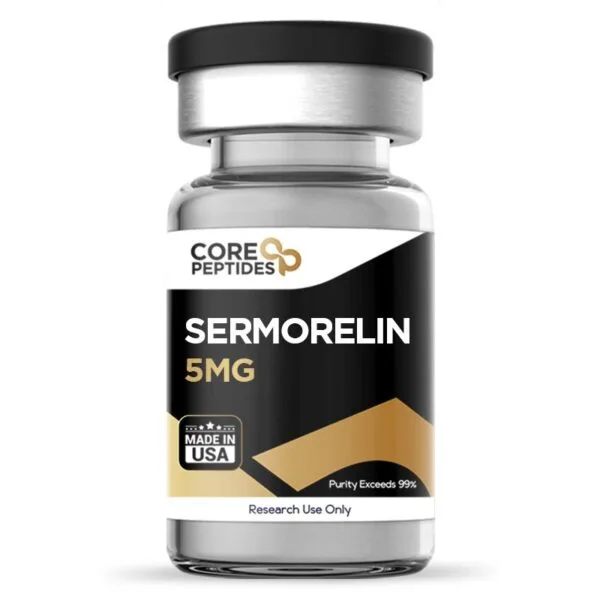
Sermorelin (5mg)
$30.00
Sermorelin 5 mg provides a high-purity, laboratory-verified lyophilized peptide manufactured under strict quality control standards in the USA. Formulated with 5 mg of pure Sermorelin (Sermorelin Acetate, GRF 1-29)—a synthetic truncated peptide corresponding to the functional 29-amino-acid N-terminal sequence of endogenous Growth Hormone-Releasing Hormone (GHRH)—this compound is widely utilized in endocrinology, somatotropic axis dynamics, and metabolic research examining pituitary somatotroph signaling, growth hormone secretion pulses, and circulating IGF-1 regulation.
Key Specifications
Active Compound: Sermorelin (GHRH 1-29 Acetate)
Chemical Formula: \text{C}_{149}\text{H}_{246}\text{N}_{44}\text{O}_{42}
Molecular Weight: 3357.9 \text{ g/mol}
Concentration: 5 mg per vial
Purity Standard: Exceeds 99% (Third-Party HPLC Verified)
Formulation: Sterile Lyophilized Powder
Origin: Manufactured in USA
Classification: Research Use Only
Primary Research Applications
Pituitary Somatotroph Stimulation: Sermorelin binds directly to GHRH receptors on anterior pituitary somatotrophs, triggering adenylate cyclase activation and promoting endogenous, pulsatile growth hormone synthesis and release.
IGF-1 Downstream Signaling: Extensively evaluated in endocrine models to observe downstream hepatic Insulin-like Growth Factor 1 (IGF-1) upregulation and its effects on cellular protein transcription and nitrogen retention.
Metabolic Rate & Tissue Regeneration: Investigated in aging and cellular repair models for its role in enhancing lipolysis, accelerating musculoskeletal recovery, and supporting tissue extracellular matrix maintenance.
Description
Sermorelin Peptide
Sermorelin is a 29 amino acid peptide, the shortest synthetically developed peptide that may potentially induce biological activity at the receptors for the growth hormone-releasing hormone (GHRH).(2) Sermorelin polypeptide is an analog of the GHRH factor consisting of GHRH (1-29 acid)-amide. Due to this structural and functional mimicry, Sermorelin has been studied across multiple branches of scientific research involving growth hormone deficiency models.(3)
It was in the early 1980s that the action of Sermorelin, classified as a growth hormone-releasing fragment GHRF (1-29) amide, was first explored. Several research studies were conducted on rats where exogenous GHRF (1-29) amide was introduced in conscious and anesthetized rats. It was observed that the presence of GHRF appeared to stimulate the pituitary gland and promote growth. Following this theory, Sermorelin and similar compounds have become the subject of further research in growth hormone deficiency models.(4)
Overview
Sermorelin is suggested to be a growth hormone analog constituting the first 29 amino acids out of the usual 44 amino acids found in growth hormone-releasing hormone (GHRH). Researchers posit that Sermorelin binds with the GHRH receptors found on the pituitary gland and suggest further that the synthetic peptide may stimulate secretion of growth hormone (hGH). Thus, Sermorelin is believed to maintain the fundamental function of GHRH, possibly stimulating the GHRH receptors in the pituitary gland and leading to sporadic release of growth hormone despite its reduced amino acid sequence. This mechanism is thought to result in increased levels of insulin-like growth factor-1 (IGF-1), primarily recognized for its role in the anabolic actions of growth hormone. The estimated half-life of Sermorelin is around 11 to 12 minutes.
A major potential advantage of the peptide is that due to its apparent GHRH receptor specificity, it may not induce any significant change in the levels of other endocrine markers such as prolactin, insulin, cortisol, glucose, or thyroid hormones.(6)
Chemical Makeup
Molecular Formula: C149H246N44O42S
Molecular Weight: 3357.93 g/mol
Other Known Titles: GRF 1-29
Research and Clinical Studies
Sermorelin and GHRH Receptors
Sermorelin is thought to interact with GHRH receptors through complex molecular mechanisms, possibly triggering various cellular signaling pathways. It is hypothesized that upon binding to the GHRH receptor, Sermorelin may alter the receptor’s structure, potentially initiating a series of intracellular signaling events.(12) Some researchers propose that Sermorelin might enhance the production of cyclic adenosine monophosphate (cAMP) in specific cells. This enhancement may occur through the activation of adenylate cyclase, which is suggested to convert ATP into cAMP. Higher levels of cAMP might lead to the activation of protein kinase A (PKA), a key enzyme in cellular signaling processes. PKA might phosphorylate various target proteins, thereby initiating further cellular responses. The potential activation of the GHRH receptor by Sermorelin, along with the ensuing cAMP-PKA signaling cascade, is thought to possibly promote the secretion and distribution of growth hormone (hGH) from somatotroph cells in the pituitary gland. The secreted hGH is also believed to contribute to the synthesis of insulin-like growth factor-1 (IGF-1).(12)
Sermorelin Peptide and Growth Velocity
Researchers reported positive results in the idiopathic GH deficiency when Sermorelin was presented to underdeveloped animal models. Increased growth and height velocity rate was observed within 12 months of consistent, continuous peptide presence. These elevated levels were reported to be sustained for an average of 36 months after continuous presence.(7)
Sermorelin Peptide and Anabolic Research Outcomes
Preliminary findings from one investigation indicate that Sermorelin may lead to an 82% enhancement in average growth hormone levels, with actions persisting for approximately two hours.(13) A separate study conducted over 16 weeks hypothesizes that Sermorelin might elevate growth hormone levels by as much as 107%, and increase IGF-1 levels by about 28%.(14) The research further suggests a possible increase in lean body mass of approximately 2.78 lbs (1.26 kg), with no significant change in fat mass. These actions are tentatively attributed to the peptide’s capacity to boost growth hormone levels, and in turn, IGF-1, which is considered a potential anabolic agent influencing growth hormone activity. The most noteworthy outcomes identified by the researchers include observations that there was “a gain of 1.26 ± 0.52 kg (P < 0.05) in LBM” and that “skin thickness increased significantly.”
Sermorelin Peptide and Lipodystrophy
Scientists carried out a controlled clinical study involving 31 HIV-positive subjects with lipodystrophy, to investigate the potential impact of Sermorelin.(8) All 31 subjects were divided into two groups, where one was presented with Sermorelin, and the other group with a placebo for 12 weeks. Following the study, it was suggested by the research team that growth hormone levels appeared significantly increased in Sermorelin subjects as compared to the ones given a placebo. Levels of insulin-like growth factor (IGF-1) had apparently increased – resulting in increased lean body mass in the peptide group. Abdominal visceral fat and the ratio of trunk to lower extremity fat were reported by the researchers to be significantly reduced. There was no other reported change in the glucose or insulin levels.(8)
Sermorelin Peptide and Cognition
In the early 2000s, clinical research studies were conducted with 89 subjects between 68 and 69 years of age to explore the correlation (if any) between tapering growth hormone release and impaired cognition. Scientists consider that with increasing age, levels of growth hormone naturally decline, which may result in reduced physiological functions, including cognition (i.e. ability to collect, process, and recollect information). Following the introduction of Sermorelin, it was observed that there was an apparent improved performance in the Wechsler Adult Intelligence Scale (WAIS) – i.e. improved IQ levels, picture arrangement tests, and verbal tests – amongst the test subjects.(9)
Sermorelin Peptide and Tumor Cells
A clinical study was designed where 1,018 glioma subjects were presented with over 4,000 compounds each, and following each presentation, a DRS was determined for all compounds, for each subject. Following the results of the study, it appeared that the Sermorelin compound reportedly induced the most sensitivity in the test subjects. Upon analysis, it was suggested by the researchers that this may be due to the potential of Sermorelin to block the tumor cell cycles, thereby possibly preventing tumor cell proliferation.(10)
Sermorelin Peptide and Hypogonadism
Initial research into the peptide suggested that Sermorelin might be impactful in increasing lean mass. One study sought to explore if Sermorelin had potential in hypogonadism (which is considered to stem from additional fat mass). Test models were divided into two groups where one group was presented with Sermorelin followed by GHRH 1-40, with a one week interval between the two compounds, whereas the other group was given the same combination in reverse order. Following the study, it was reported by the researchers that for both groups, the Sermorelin appeared to stimulate the release of FSH and LH, which might stimulate testosterone production.
This initial research spawned additional studies, including one clinical study that included 19 male subjects, 9 of whom were aged between 22 and 33 years of age, and 10 were aged between 60 and 78 years of age. The more elderly subjects were presented with one of two concentrations of Sermorelin for a period of 28 days, with an interval of 14 days in between the two instances. Testosterone levels in the elderly subjects reportedly increased after the presentation of Sermorelin; however, it should be noted that the levels were not statistically significant. Furthermore, researchers suggested that elevated levels of growth hormones, possibly induced by Sermorelin presence, appeared to be at peak during the night time, for all test subjects, as compared during the day.
References:
- Garcia JM, Merriam GR, Kargi AY. Growth Hormone in Aging. [Updated 2019 Oct 7]. In: Feingold KR, Anawalt B, Boyce A, et al., editors. Endotext [Internet]. South Dartmouth (MA): MDText.com, Inc.; 2000. https://www.ncbi.nlm.nih.gov/books/NBK279163/?report=reader
- Prakash, A, and K L Goa. “Sermorelin: a review of its use in the diagnosis and treatment of children with idiopathic growth hormone deficiency.” BioDrugs : clinical immunotherapeutics, biopharmaceuticals and gene therapy vol. 12,2 (1999): 139-57. https://pubmed.ncbi.nlm.nih.gov/18031173/
- National Center for Biotechnology Information. “PubChem Compound Summary for CID 16129620, Sermorelin” PubChem
- Clark, R G, and I C Robinson. “Growth induced by pulsatile infusion of an amidated fragment of human growth hormone releasing factor in normal and GHRF-deficient rats.” Nature vol. 314,6008 (1985): 281-3. https://pubmed.ncbi.nlm.nih.gov/2858818/
Reviews (0)
Be the first to review “Sermorelin (5mg)” Cancel reply
Shipping and Delivery
MAECENAS IACULIS
Vestibulum curae torquent diam diam commodo parturient penatibus nunc dui adipiscing convallis bulum parturient suspendisse parturient a.Parturient in parturient scelerisque nibh lectus quam a natoque adipiscing a vestibulum hendrerit et pharetra fames nunc natoque dui.
ADIPISCING CONVALLIS BULUM
- Vestibulum penatibus nunc dui adipiscing convallis bulum parturient suspendisse.
- Abitur parturient praesent lectus quam a natoque adipiscing a vestibulum hendre.
- Diam parturient dictumst parturient scelerisque nibh lectus.
Scelerisque adipiscing bibendum sem vestibulum et in a a a purus lectus faucibus lobortis tincidunt purus lectus nisl class eros.Condimentum a et ullamcorper dictumst mus et tristique elementum nam inceptos hac parturient scelerisque vestibulum amet elit ut volutpat.
Related products
AOD 9604 (5mg)
$41.00
AOD 9604 5mg is a premium, high-purity (\ge99% HPLC-verified) synthetic analog of the C-terminal region of human growth hormone (hGH 177-191). Engineered specifically to isolate lipolytic receptor activity without elevating IGF-1 levels or altering glucose metabolism, AOD 9604 is an essential tool for laboratory studies targeting lipid metabolism, adipocyte signaling, and cartilage matrix regeneration. Supplied as a sterile lyophilized powder strictly for scientific research use.
Epithalon (25mg)
$90.00
Epithalon 25 mg is a research-grade lyophilized tetrapeptide engineered for high-purity laboratory applications. Each vial contains 25 mg of HPLC-verified Epithalon, third-party tested to guarantee over 99% purity and manufactured in the USA under strict standards. Formulated specifically for research investigating telomerase enzyme induction, pineal function restoration, and cellular longevity pathways, this product is strictly intended for research use only.
Humanin (10mg)
$145.00
Humanin 10 mg provides a high-purity, laboratory-verified lyophilized peptide manufactured under strict quality control standards in the USA. Formulated with 10 mg of pure Humanin—a naturally occurring 24-amino-acid micropeptide encoded within the mitochondrial genome (16S rRNA)—this compound is widely utilized in cellular biology, metabolic health, and neurodegenerative disease research investigating cytoprotective mechanisms, oxidative stress regulation, and insulin sensitivity pathways.
Key Specifications
Active Compound: Humanin (HN)
Chemical Formula: \text{C}_{119}\text{H}_{204}\text{N}_{34}\text{O}_{35}\text{S}_{2}
Concentration: 10 mg per vial
Purity Standard: Exceeds 99% (Third-Party HPLC Verified)
Formulation: Sterile Lyophilized Powder
Origin: Manufactured in USA
Classification: Research Use Only
Primary Research Applications
Cytoprotection & Anti-Apoptotic Pathways: Humanin is studied for its ability to suppress Bax-mediated apoptosis, protecting various cell lines against programmed cell death triggered by toxic insults.
Neuroprotective Dynamics: Extensively evaluated in Alzheimer’s disease and neurodegenerative models to analyze its role in mitigating amyloid-beta (A\beta) cytotoxicity and preserving neuronal function.
Mitochondrial & Metabolic Homeostasis: Investigated for its regulatory actions on insulin sensitivity, glucose metabolism, and cellular homeostasis under conditions of metabolic stress.
Receptor Grade IGF-1 LR3 (1mg)
$150.00
IGF-1 LR3 Receptor Grade 1 mg provides a high-purity, laboratory-verified lyophilized recombinant peptide manufactured under strict quality control standards in the USA. Formulated with 1 mg of pure Long \text{R}^3 Insulin-like Growth Factor-1, this modified analog features an arginine substitution at position 3 and a 13-amino-acid N-terminal extension. Specifically designated as receptor grade, this compound exhibits significantly reduced binding affinity for IGF binding proteins (IGFBPs), allowing researchers to study prolonged, uninhibited receptor-ligand interactions and cellular proliferation dynamics.
Key Specifications
Active Compound: IGF-1 LR3 (Long Arginine 3 IGF-1)
Grade: Receptor Grade
Concentration: 1 mg per vial
Purity Standard: Exceeds 99% (Third-Party HPLC Verified)
Formulation: Sterile Lyophilized Powder
Origin: Manufactured in USA
Classification: Research Use Only
Primary Research Applications
IGFBP Resistance & Extended Half-Life: The structural modification drastically lowers binding to IGF-binding proteins, enabling researchers to observe sustained activation of the IGF-1 receptor (IGF-1R) without rapid metabolic inactivation.
Cellular Proliferation & Protein Synthesis: Widely applied in vitro to study MAPK/ERK and PI3K/Akt/mTOR signaling pathways involved in cell growth, myogenesis, and nutrient transport regulation.
Hyperplasia & Tissue Culture Assays: Utilized in research models measuring satellite cell activation, skeletal muscle fiber recruitment, and metabolic shift mechanics.
Retatrutide (10mg)
$130.00
Retatrutide (10mg) is a multi-target triple agonist peptide engineered to hit GLP-1, GIP, and glucagon receptors. Designed to evaluate advanced weight loss and metabolic regulation, it delivers greater energy expenditure and appetite control in preclinical studies. High-purity lyophilized powder for laboratory research.
Semax (25mg)
$60.00
Semax (25mg) is a premium research-grade synthetic heptapeptide (≥98% purity) studied for its potent neuroprotective, memory-enhancing, and BDNF-boosting properties. Supplied as a stable, lyophilized powder, every batch is HPLC and Mass Spectrometry verified to ensure maximum purity and consistency for laboratory investigation.
For research and laboratory use only. Not for human consumption.
Tesamorelin & Ipamorelin Blend (8mg)
$90.00
Tesamorelin 6 mg / Ipamorelin 2 mg is a research-grade lyophilized peptide blend engineered for high-purity laboratory applications. Each vial contains an 8 mg total blend (6 mg Tesamorelin / 2 mg Ipamorelin), third-party HPLC-tested to guarantee over 99% purity and manufactured in the USA under strict standards. Formulated specifically for research investigating dual GHRH and GHSR receptor activation, visceral fat metabolism, and endocrine signaling pathways, this product is strictly intended for research use only.
VIP Peptide (6mg)
$64.00
VIP Peptide 6 mg provides a high-purity, laboratory-verified lyophilized peptide manufactured under strict quality control standards in the USA. Formulated with 6 mg of pure Vasoactive Intestinal Peptide (VIP)—a naturally occurring 28-amino-acid neuropeptide belonging to the secretin/glucagon superfamily—this compound is widely utilized in immunology, neurobiology, gastroenterology, and cardiovascular research examining immunomodulatory cascades, smooth muscle relaxation, and suprachiasmatic nucleus circadian clock synchronization.
Key Specifications
Active Compound: Vasoactive Intestinal Peptide (VIP)
Chemical Formula: \text{C}_{147}\text{H}_{238}\text{N}_{44}\text{O}_{42}\text{S}
Concentration: 6 mg per vial
Purity Standard: Exceeds 99% (Third-Party HPLC Verified)
Formulation: Sterile Lyophilized Powder
Origin: Manufactured in USA
Classification: Research Use Only
Primary Research Applications
Immunomodulation & Anti-Inflammatory Pathways: VIP acts via VPAC1 and VPAC2 receptors to inhibit pro-inflammatory cytokines (TNF-\alpha, IL-6, IL-12) while upregulating anti-inflammatory pathways (IL-10), making it a benchmark subject in autoimmune and chronic inflammatory signaling research.
Vascular & Pulmonary Smooth Muscle Regulation: Evaluated in cardiovascular and respiratory models for its potent vasodilatory properties, pulmonary arterial pressure regulation, and airway bronchodilator mechanisms.
Circadian Rhythm & Neuroendocrine Signaling: Extensively studied in suprachiasmatic nucleus (SCN) neuronal models to analyze central biological clock entrainment, neuropeptide release dynamics, and intestinal mucosal signaling.


Reviews
There are no reviews yet.