
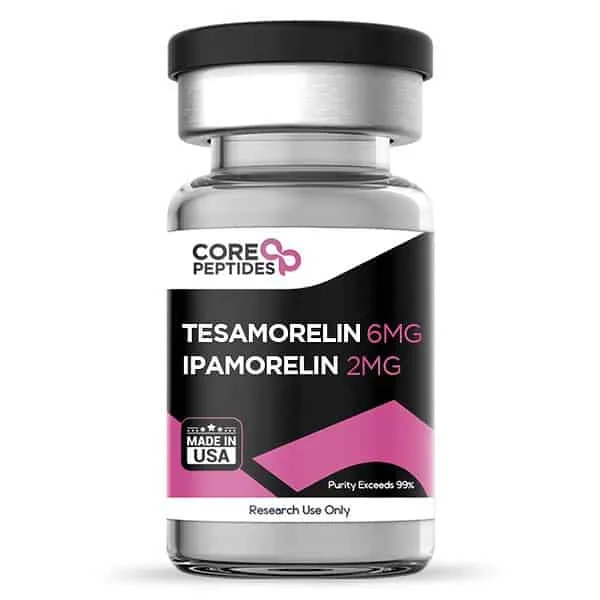
Tesamorelin & Ipamorelin Blend (8mg)
$90.00
Size: 8mg
Contents: Tesamorelin (6mg) & Ipamorelin (2mg)
Form: Lyophilized powder
Purity: >99%
SKU: TESA-IPA-8MG
FREE Shipping on $200+ orders
| Quantity | Discount | Price |
|---|---|---|
| 5 – 8 | 5% | $85.50 |
| 9 + | 10% | $81.00 |
Tesamorelin & Ipamorelin Peptide Blend
The Tesamorelin and Ipamorelin blend consists of two peptides that appear to share the potential to stimulate the growth hormone axis, albeit through differing mechanisms. This combination may synergistically activate the pituitary gland, which research suggests results in the release of endogenous growth hormone. The blend seems to offer a potential means to optimize growth hormone levels and may elicit effects on sleep, metabolic function, cognition, muscle tissue, lean mass, and lipid profiles.(1)(2)
It is possible that the combination of Tesamorelin and Ipamorelin may yield a range of impacts, which may include improved deep sleep, reduced levels of triglycerides, visceral adipose tissue (VAT), and carotid intima-media thickness (cIMT), enhanced cognition, and possible overall optimization of metabolic function. This blend appears to present an opportunity to harness the synergistic actions of both to potentially augment natural growth hormone levels.
Chemical Makeup(3)(4)
Molecular Formula
- Tesamorelin: C221H366N72O67S
- Ipamorelin: C38H49N9O5
Molecular Weight
- Tesamorelin: 5136 g/mol
- Ipamorelin: 711.8 g/mol
Sequence
- Tesamorelin: Unk-Tyr-Ala-Asp-Ala-Ile-Phe-Thr-Asn-Ser-Tyr-Arg-Lys-Val-Leu-Gly-Gln-Leu-Ser-Ala-Arg-Lys-Leu-Leu-Gln-Asp-Ile-Met-Ser-Arg-Gln-Gln-Gly-Glu-Ser-Asn-Gln-Glu-Arg-Gly-Ala-Arg-Ala-Arg-Leu-NH2
- Ipamorelin: H-Aib-His-D-2Nal-D-Phe-Lys-NH2
Other Known Titles
- Tesamorelin: (3E)-hex-3-enoylsomatoliberin
- Ipamorelin: Ipamorelin Acetate, Aib-His-D-2-Nal-D-Phe-Lys-NH2
Research and Clinical Studies
Tesamorelin & Ipamorelin Blend and Growth Hormone Deficiency
The Tesamorelin and Ipamorelin blend appears to exert its potential through distinct yet complementary proposed mechanisms of action. Tesamorelin, a growth hormone-releasing hormone (GHRH) analog, appears to act by binding to and activating the GHRH receptor on somatotrophs in the pituitary gland. This stimulation potentially triggers the synthesis and secretion of endogenous growth hormone (GH) in a pulsatile manner. By promoting GH release, Tesamorelin may possibly enhance lipolysis, reduce visceral adipose tissue, and also potentially improve glucose metabolism.
Ipamorelin, a growth hormone secretagogue receptor (GHSR) agonist, by contrast, appears to activate GHSR in the hypothalamus and peripheral tissues, potentially leading to the release of GH. This peptide appears to exhibit a high selectivity for GHSR, potentially without interfering with other hormones. This GHSR activation by Ipamorelin may result in increased GH secretion, which, in turn, might promote protein synthesis, lipolysis, and insulin-like growth factor-1 (IGF-1) production, as suggested by researchers.
When combined, the Tesamorelin and Ipamorelin blend may provide a synergistic impact by targeting different components of the growth hormone axis. Tesamorelin has been suggested to enhance GHRH-mediated GH release, while Ipamorelin has been suggested to directly stimulate GHSR to increase GH secretion. This dual action appears to amplify the overall GH, such as improved body composition, lipid profile, insulin sensitivity, and overall metabolic function in laboratory test models. By seemingly targeting the growth hormone axis through their supposed distinct mechanisms of action, Tesamorelin and Ipamorelin may collectively stimulate the pituitary gland, thereby potentially enhancing the release of endogenous growth hormone.(5)
Tesamorelin & Ipamorelin Blend and the Pituitary Gland
The Tesamorelin and Ipamorelin blend appears to exhibit some impact on the pituitary gland, a critical endocrine organ considered responsible for the regulation of growth hormone secretion.
Studies suggest that Tesamorelin may specifically target the growth hormone-releasing hormone receptor (GHRHR), potentially activating the signaling cascade that leads to growth hormone synthesis and subsequent release. As per the researchers, “Tesamorelin is a synthetic growth hormone-releasing hormone that acts on the anterior pituitary gland to stimulate the endogenous growth hormone secretion.”(6)
Studies suggest that the peptide may potentially cause a 69% increase in total growth hormone levels (apparently assessed via area under the curve – AUC) and a purported 55% increase in the mean pulse area of the growth hormone. The peptide was not reported to affect growth hormone pulse frequency or peak growth hormone levels.(7)
Ipamorelin, on the other hand, studies suggest may act as a potent agonist for the growth hormone secretagogue receptor (GHSR), seemingly promoting growth hormone secretion.(8) As stated in the studies, “Ipamorelin is the first GHRP-receptor agonist with a selectivity for GH release similar to that displayed by GHRH. The specificity of ipamorelin makes this compound a very interesting candidate for future clinical development.”(8)
Ipamorelin may have exhibited a propensity to elevate growth hormone levels, potentially reaching heights of up to 80mIU/l (equivalent to an approximate concentration of 26.6ng/ml). When expressed as a percentage increase in comparison to a placebo (1.31mIU/l or 0.4ng/ml), this augmentation appears to surpass 60-fold.(9)
When combined, these peptides appear to exert a synergistic action on the pituitary gland, which might result in enhanced growth hormone production. This proposed synergistic interaction between Tesamorelin and Ipamorelin may offer a promising avenue for research in optimizing growth hormone levels.
Tesamorelin & Ipamorelin Blend and Lipodystrophy
Research studies frequently indicate that lipodystrophy is often accompanied by insulin resistance, dyslipidemia, and an increased risk of cardiovascular complications. Clinical studies have suggested that Tesamorelin presentation in lipodystrophic test subjects might lead to a reduction in visceral adipose tissue (VAT) and improvements in insulin sensitivity and lipid profiles. Tesamorelin appears to act through the activation of the growth hormone-releasing hormone receptor (GHRHR), potentially stimulating endogenous growth hormone secretion and promoting lipolysis; and potentially preserving “abdominal subcutaneous adipose tissue, improving body image and lipids”.(10)
Similarly, Ipamorelin has been reported to exhibit some promise in influencing adipose tissue metabolism. By combining Tesamorelin and Ipamorelin, it is hypothesized by researchers that the synergistic potential of these peptides may enhance the reduction of VAT and improve metabolic parameters in lipodystrophy test models.(10)
Tesamorelin & Ipamorelin Blend and Type 2 Diabetes
Preclinical and clinical studies have suggested that both Tesamorelin and Ipamorelin hold promise in improving glycemic control and mitigating the metabolic abnormalities associated with T2DM. Tesamorelin appears to stimulate endogenous growth hormone secretion, which has been long considered by scientists to enhance insulin sensitivity and glucose utilization. Ipamorelin studies also indicate that the peptide may influence glucose metabolism and insulin sensitivity. Combining Tesamorelin and Ipamorelin may provide complementary effects, which could also include reductions in hemoglobin A1c (HbA1c) levels, possible improvements in insulin sensitivity, and possible reductions in visceral adiposity in individuals with Type II Diabetes Mellitus.(11)
Tesamorelin & Ipamorelin and Cognitive Improvement
Studies have indicated that growth hormone and its secretagogues, such as Tesamorelin and Ipamorelin, might play a role in neuroplasticity, neuronal survival, and synaptic plasticity, all of which are considered critical for optimal cognitive performance.
Preclinical research has further suggested that Tesamorelin introduction may improve memory and learning abilities, possibly through its proposed impact on neurogenesis and synaptic plasticity. Furthermore, Ipamorelin has been suggested to enhance spatial memory and cognitive function in animal models. The combined influence of Tesamorelin and Ipamorelin may potentially amplify these cognitive benefits through their complementary mechanisms of action. By stimulating the growth hormone axis and modulating neurotrophic factors, this blend holds promise in cognitive improvement research.
Tesamorelin & Ipamorelin Blend and Muscle Density
In one of the aforementioned scientific examinations, the potential effects of Tesamorelin on muscle tissue integrity were assessed utilizing computed tomography (CT) scans. The results posited that there might be a relationship between Tesamorelin and enhancements in muscle density and size. Interestingly, certain muscle groups, notably the rectus abdominis, psoas major, and paraspinal muscles, appeared to display more pronounced changes, which were typified by either an augmentation in muscle density and size or a diminution in fat content. Statistically, these changes were distinct when compared with placebo. Yet, while it is believed that Tesamorelin’s mechanism might be interconnected with molecules such as IGF-1, the study found no significant linkage between IGF-1 level shifts and modifications in muscle dimensions or density.(6)
In parallel, early explorations employing experimental frameworks have posited that Ipamorelin may potentially manifest actions akin to those observed with Tesamorelin in relation to skeletal muscle and bone structures. Yet, these observations are yet to be definitively corroborated. Delving deeper, it was suggested that Ipamorelin might interface with, and perhaps elevate, IGF-I concentrations. Such interactions seemed to correlate with a surge in muscle fiber dimensions, overall muscle volume, and consequently, a potential amplification in skeletal muscle robustness during this murine investigation.(12)
Tesamorelin & Ipamorelin Blend and Bone Density
Ipamorelin seems to have a positive impact on bone health, potentially stimulating bone formation and fostering an enhancement in bone mass. The research posited a possible augmentation in bone mineral content that could be related to Ipamorelin. Various murine trials have alluded to the favorable effects of Ipamorelin on bone tissue.(13) (14) One specific murine study delved into the effects of Ipamorelin on bone mineral content (BMC). The findings proposed that there might be a surge in the test animals’ body weight and BMC, possibly discerned through dual X-ray absorptiometry. Yet, when standardized for body weight variations, the BMC to body weight ratio appeared consistent. An in vitro examination also indicated that the rise in cortical BMC could be attributed to an enlarged bone area, while the volumetric BMD seems to be stable.
Tesamorelin & Ipamorelin Blend on Appetite and Digestion
The interaction of Ipamorelin with ghrelin receptors appears to have implications for appetite modulation, potentially leading to augmented weight gain. One investigation posited that subjects exposed to Ipamorelin observed a roughly 15% ascent in body weight. It is suggested that this compound might have selectively amplified fat pad weights in relation to total body mass. Consequently, dual-energy X-ray absorptiometry assessments could reveal a nuanced increase in body fat composition. Emerging data also hints that Ipamorelin might elevate serum leptin levels, a hormone integral to energy and appetite regulation. This prompts the scientific community to consider the possibility that heightened food consumption may play a role in the documented weight augmentation within the Ipamorelin cohorts.(15)
In addition, activating the ghrelin receptor also appears to affect digestion. Thus, researchers delved into the possible effects of Ipamorelin on gastric functions compared to placebo, with a spotlight on its purported ability to expedite gastric emptying. To gauge this, they employed an intricate technique that tracked the residual radioactivity in the stomach 15 minutes after the introduction of a specific substance through intragastric gavage. It was posited that abdominal surgical interventions might have played a role in decelerating gastric emptying, a phenomenon seemingly prominent in the placebo control cohort. In contrast, Ipamorelin appeared to expedite this emptying process relative to the control group. These observations suggested the potential of Ipamorelin in augmenting the rate of gastric emptying.(16)
Diving deeper, the team sought to unravel the effects of this compound on the contractile dynamics of gastric smooth muscles when exposed to acetylcholine and electrical field stimulation. Data hinted that surgical manipulations of the intestines might markedly dampen the contractile responses to both inducements. Yet, intriguingly, this inhibitory effect seemed to be mitigated when Ipamorelin was co-presented with ghrelin. This introduces the tentative proposition that Ipamorelin might not just enhance gastric muscle contractility, but also possibly counterbalance the repressive outcomes instigated by specific surgical measures.

Reviews
There are no reviews yet.