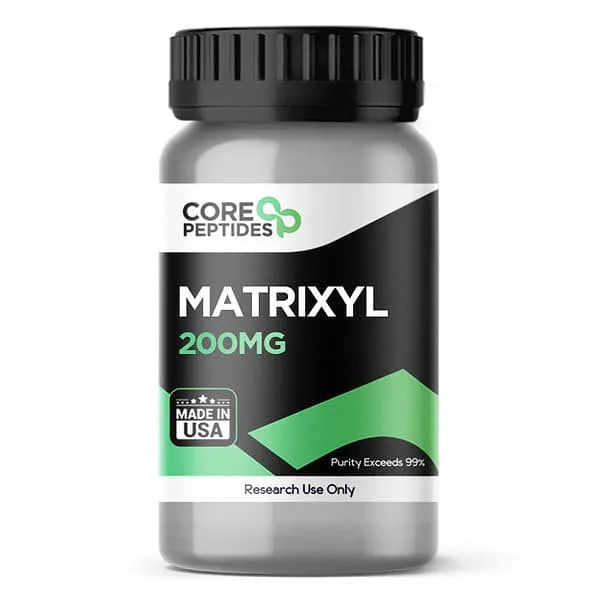
Matrixyl (200mg)
$170.00
Matrixyl, also known as as palmitoyl pentapeptide-4 or palmitoyl pentapeptide-3, is a synthetic peptide currently under scientific investigation for its potential to stimulate collagen production in the skin. It is classified as a matrikine – a messenger peptide that may regulate cell activities by interacting with their specific receptors. Collagen is a protein that is considered to support flexibility and structural integrity in the extracellular matrix of the skin. The conjugation with the palmitoyl introduces the potential for more consistent delivery across the skin and better stability to skin proteases.
Size: 200mg
Contents: Matrixyl
Form: Lyophilized powder
Purity: >99%
SKU: P-Matrixyl
FREE Shipping on $200+ orders
Description
Matrixyl
Matrixyl, also known as as palmitoyl pentapeptide-4 or palmitoyl pentapeptide-3, is a synthetic peptide currently under scientific investigation for its potential to stimulate collagen production in the skin. It is classified as a matrikine – a messenger peptide that may regulate cell activities by interacting with their specific receptors. Collagen is a protein that is considered to support flexibility and structural integrity in the extracellular matrix of the skin. The conjugation with the palmitoyl introduces the potential for more consistent delivery across the skin and better stability to skin proteases.(1)
Chemical Makeup
Molecular formula: C39H75N7O10
Molecular weight: 802.05 g/mol
Other known titles: Palmitoyl pentapeptide-4, (palmitoyl pentapeptide-3 prior to 2006)
Research and Clinical Studies
Matrixyl Peptide and Collagen Synthesis
Studies suggest that Matrixyl may act as a signal peptide fragment of the C-terminal propeptide of type I collagen.(2) The scientists indicate that it may act by signaling fibroblasts and “stimulates feedback regulation of new collagen synthesis and ECM proteins.” Fibroblasts are a type of cell that is found in connective tissue. They play a crucial role in forming and maintaining the extracellular matrix (ECM), a complex network of proteins and carbohydrates that provides structural support to tissues and organs. The main extracellular matrix proteins are collagens, elastins, fibronectins, and laminins. Fibroblasts produce and secrete collagen, the ECM’s main structural protein. Collagen provides tensile strength to tissues and organs and is essential for maintaining their shape and integrity. During wound healing, fibroblasts are responsible for depositing new collagen fibers to replace damaged tissue. Researchers suggested that Matrixyl may potentially stimulate collagen production in a concentration-dependent manner close to the critical aggregation concentration, indicating that self-assembly and collagen production are interrelated.(3) Self-assembly of peptides includes hydrogen bonds, electrostatic interactions, hydrophobic interactions, aromatic interactions (ĻāĻ stacking), and van der Waals forces.
Matrixyl Peptide and Wrinkles
Several studies suggest some potential for Matrixyl to induce action on fibroblasts and collagen synthesis. One research study examined its potential in research models of bi-lateral exposure to Matrixyl peptide and placebo, respectively.(5) The study reported that the peptide appeared to have reduced overall wrinkle depth compared to the placebo control.
An additional study aimed to investigate the cellular activity of Matrixyl.(6) A compound infused with Matrixyl was introduced twice daily to the periorbital area of the research model for a duration of 8 weeks. The results indicated improvements via the exposure to Matrixyl, which appeared to exhibit better results when compared to other peptides and placebo based on measured data.
Another study aimed to isolate the potential of Matrixyl to improve skin surface texture and wrinkle depth in the periorbital region.(7) Two double-blind, randomized, controlled studies were conducted in research models of moderate to distinct periorbital wrinkles. After 4 weeks, the peptide was reported by researchers to have appeared to reduced the texture of periorbital skin and reduced the apparent depth of larger wrinkles.
Matrixyl Peptide and Scarring
One study investigated the potential of Matrixyl on fibroblast contractility and its potential role in scar formation.(8) Matrixyl was reported to reduce the expression of α-SMA (alpha-smooth muscle actin) and inhibit the trans-differentiation of fibroblasts to myofibroblasts. Scientists indicate alpha smooth muscle actin (α-SMA) is a protein commonly found in smooth muscle cells, including those in blood vessels and hollow organs such as the intestines and bladder. It is also considered to be expressed by a specialized type of cell called a myofibroblast, which plays a key role in wound healing and tissue repair. In the context of fibrotic scarring, the expression of α-SMA by myofibroblasts is associated with the deposition of excess collagen and the development of scar tissue.
Matrixyl Peptide and Tissue Repair
One animal study investigated the potential of Matrixyl in promoting wound healing. Animals were divided into seven groups and monitored for 21 days.(9) Results suggested that Matrixyl may positively impact wound healing, with larger potential seen in the high-concentration Matrixyl groups compared to a positive control group. The scientists reported that “the macroscopic results showed that wound healing was improved from 63.5 up to 81.81% in treatment groups compared to that in the negative control group.”
Another article described the development of a novel conjugate of Matrixyl with imidazolium-based ionic liquid.(10) Imidazolium-based ionic liquids have antimicrobial and skin penetration properties. These conjugates also have collagenesis-inducing activity comparable to the proposed efficacy of Matrixyl.
References:
- Choi, Y. L., Park, E. J., Kim, E., Na, D. H., & Shin, Y. H. (2014). Dermal Stability and In Vitro Skin Permeation of Collagen Pentapeptides (KTTKS and palmitoyl-KTTKS). Biomolecules & therapeutics, 22(4), 321ā327. https://doi.org/10.4062/biomolther.2014.053
- Errante, F., LedwoÅ, P., Latajka, R., Rovero, P., & Papini, A. M. (2020). Cosmeceutical Peptides in the Framework of Sustainable Wellness Economy. Frontiers in chemistry, 8, 572923. https://doi.org/10.3389/fchem.2020.572923
- Jones, R. R., Castelletto, V., Connon, C. J., & Hamley, I. W. (2013). Collagen stimulating effect of peptide amphiphile C16-KTTKS on human fibroblasts. Molecular pharmaceutics, 10(3), 1063ā1069. https://doi.org/10.1021/mp300549d
Reviews (0)
Be the first to review “Matrixyl (200mg)” Cancel reply
Shipping and Delivery
MAECENAS IACULIS
Vestibulum curae torquent diam diam commodo parturient penatibus nunc dui adipiscing convallis bulum parturient suspendisse parturient a.Parturient in parturient scelerisque nibh lectus quam a natoque adipiscing a vestibulum hendrerit et pharetra fames nunc natoqueĀ dui.
ADIPISCING CONVALLIS BULUM
- Vestibulum penatibus nunc dui adipiscing convallis bulum parturient suspendisse.
- Abitur parturient praesent lectus quam a natoque adipiscing a vestibulum hendre.
- Diam parturient dictumst parturient scelerisque nibh lectus.
Scelerisque adipiscing bibendum sem vestibulum et in a a a purus lectus faucibus lobortis tincidunt purus lectus nisl class eros.Condimentum a et ullamcorper dictumst mus et tristique elementum nam inceptos hac parturient scelerisqueĀ vestibulum amet elit ut volutpat.
Related products
B7-33 (6mg)
$60.00
B7-33 6 mg provides a high-purity, laboratory-verified lyophilized peptide manufactured under strict quality control standards in the USA. Formulated with 6 mg of pure B7-33āa single-chain synthetic peptide functional analog of human gene-2 relaxin (H2 relaxin)āthis compound is widely utilized in cardiovascular, nephrology, and matrix biology research examining selective RXFP1 receptor signaling, extracellular matrix (ECM) remodeling, and anti-fibrotic signaling pathways without inducing tumor growth pathways.
Key Specifications
Active Compound: B7-33 (Relaxin-2 Receptor Agonist)
Chemical Formula: \text{C}_{136}\text{H}_{210}\text{N}_{40}\text{O}_{41}
Concentration: 6 mg per vial
Purity Standard: Exceeds 99% (Third-Party HPLC Verified)
Formulation: Sterile Lyophilized Powder
Origin: Manufactured in USA
Classification: Research Use Only
Primary Research Applications
Targeted Anti-Fibrotic Activity: B7-33 acts through the RXFP1 receptor to upregulate matrix metalloproteinases (MMPs) and suppress excessive collagen deposition, providing a targeted model for reversal of organ fibrosis.
Cardiovascular & Renal Remodeling: Extensively evaluated in preclinical models of heart failure, renal scarring, and vascular stiffness to assess hemodynamic regulation and arterial compliance enhancement.
Biasing RXFP1 Receptor Signaling: Investigated for its ability to preferentially stimulate pERK signaling over cAMP accumulation, preventing unwanted inotropic or proliferative side effects associated with full-length native relaxin.
Pinealon Peptide (20mg)
$75.00
Pinealon Peptide 20 mg is a research-grade lyophilized tripeptide engineered for high-purity laboratory applications. Each vial contains 20 mg of HPLC-verified Pinealon, third-party tested to guarantee over 99% purity and manufactured in the USA under strict standards. Formulated specifically for research investigating neuroprotection, pineal gene expression, and cognitive function optimization, this product is strictly intended for research use only.
Receptor Grade IGF-1 LR3 (1mg)
$150.00
IGF-1 LR3 Receptor Grade 1 mg provides a high-purity, laboratory-verified lyophilized recombinant peptide manufactured under strict quality control standards in the USA. Formulated with 1 mg of pure Long \text{R}^3 Insulin-like Growth Factor-1, this modified analog features an arginine substitution at position 3 and a 13-amino-acid N-terminal extension. Specifically designated as receptor grade, this compound exhibits significantly reduced binding affinity for IGF binding proteins (IGFBPs), allowing researchers to study prolonged, uninhibited receptor-ligand interactions and cellular proliferation dynamics.
Key Specifications
Ā Active Compound: IGF-1 LR3 (Long Arginine 3 IGF-1)
Ā Grade: Receptor Grade
Ā Concentration: 1 mg per vial
Ā Purity Standard: Exceeds 99% (Third-Party HPLC Verified)
Ā Formulation: Sterile Lyophilized Powder
Ā Origin: Manufactured in USA
Ā Classification: Research Use Only
Primary Research Applications
Ā IGFBP Resistance & Extended Half-Life: The structural modification drastically lowers binding to IGF-binding proteins, enabling researchers to observe sustained activation of the IGF-1 receptor (IGF-1R) without rapid metabolic inactivation.
Ā Cellular Proliferation & Protein Synthesis: Widely applied in vitro to study MAPK/ERK and PI3K/Akt/mTOR signaling pathways involved in cell growth, myogenesis, and nutrient transport regulation.
Ā Hyperplasia & Tissue Culture Assays: Utilized in research models measuring satellite cell activation, skeletal muscle fiber recruitment, and metabolic shift mechanics.
Semaglutide 5 mg
$70.00
Semaglutide 5 mg is a research-grade lyophilized peptide engineered for high-purity laboratory applications. Each vial contains 5 mg of HPLC-verified Semaglutide, third-party tested to guarantee over 99% purity and manufactured in the USA under strict quality standards. Formulated specifically for research investigating GLP-1 receptor activation, glucose-dependent insulin secretion, gastric emptying regulation, and metabolic homeostasis pathways, this product is strictly intended for research use only.
TB-500 (Thymosin Beta 4) 10 mg
$130.00
TB-500 provides a high-purity, laboratory-verified lyophilized peptide manufactured under strict quality control standards in the USA. Formulated with pure TB-500 (a synthetic region of the naturally occurring peptide Thymosin Beta-4), this compound is widely utilized in cellular, vascular, and tissue engineering research investigating actin sequestration, cell migration, angiogenesis, and repair pathways in connective tissue models.
Key Specifications
Ā Active Compound: TB-500 (Thymosin Beta-4 Fragment)
Ā Purity Standard: Exceeds 99% (Third-Party HPLC Verified)
Ā Formulation: Sterile Lyophilized Powder
Ā Origin: Manufactured in USA
Ā Classification: Research Use Only
Primary Research Applications
Ā Actin Sequestration & Cytoskeletal Dynamics: TB-500 binds to G-actin to regulate actin polymerization, making it a valuable tool for studying cellular structure reorganization, motility, and wound healing kinetics.
Ā Angiogenesis & Vascular Remodeling: Evaluated in endothelial cell assays to analyze new blood vessel formation, endothelial cell migration, and microvascular regeneration.
Ā Tissue Repair & Extracellular Matrix (ECM) Modulation: Extensively investigated in preclinical models measuring collagen deposition, tendon/ligament repair signaling, and localized inflammation attenuation.
Tesamorelin & Ipamorelin Blend (8mg)
$90.00
Tesamorelin 6 mg / Ipamorelin 2 mg is a research-grade lyophilized peptide blend engineered for high-purity laboratory applications. Each vial contains an 8 mg total blend (6 mg Tesamorelin / 2 mg Ipamorelin), third-party HPLC-tested to guarantee over 99% purity and manufactured in the USA under strict standards. Formulated specifically for research investigating dual GHRH and GHSR receptor activation, visceral fat metabolism, and endocrine signaling pathways, this product is strictly intended for research use only.
Tirzepatide (5mg)
$90.00
Tirzepatide (5mg) is a dual GIP and GLP-1 receptor agonist designed to study advanced weight loss, lipid metabolism, and glycemic control. Engineered for high potency, this peptide targets dual incretin pathways to optimize metabolic research outcomes. Supplied as a high-purity lyophilized powder for laboratory use.
VIP Peptide (6mg)
$64.00
VIP Peptide 6 mg provides a high-purity, laboratory-verified lyophilized peptide manufactured under strict quality control standards in the USA. Formulated with 6 mg of pure Vasoactive Intestinal Peptide (VIP)āa naturally occurring 28-amino-acid neuropeptide belonging to the secretin/glucagon superfamilyāthis compound is widely utilized in immunology, neurobiology, gastroenterology, and cardiovascular research examining immunomodulatory cascades, smooth muscle relaxation, and suprachiasmatic nucleus circadian clock synchronization.
Key Specifications
Active Compound: Vasoactive Intestinal Peptide (VIP)
Chemical Formula: \text{C}_{147}\text{H}_{238}\text{N}_{44}\text{O}_{42}\text{S}
Concentration: 6 mg per vial
Purity Standard: Exceeds 99% (Third-Party HPLC Verified)
Formulation: Sterile Lyophilized Powder
Origin: Manufactured in USA
Classification: Research Use Only
Primary Research Applications
Immunomodulation & Anti-Inflammatory Pathways: VIP acts via VPAC1 and VPAC2 receptors to inhibit pro-inflammatory cytokines (TNF-\alpha, IL-6, IL-12) while upregulating anti-inflammatory pathways (IL-10), making it a benchmark subject in autoimmune and chronic inflammatory signaling research.
Vascular & Pulmonary Smooth Muscle Regulation: Evaluated in cardiovascular and respiratory models for its potent vasodilatory properties, pulmonary arterial pressure regulation, and airway bronchodilator mechanisms.
Circadian Rhythm & Neuroendocrine Signaling: Extensively studied in suprachiasmatic nucleus (SCN) neuronal models to analyze central biological clock entrainment, neuropeptide release dynamics, and intestinal mucosal signaling.


Reviews
There are no reviews yet.