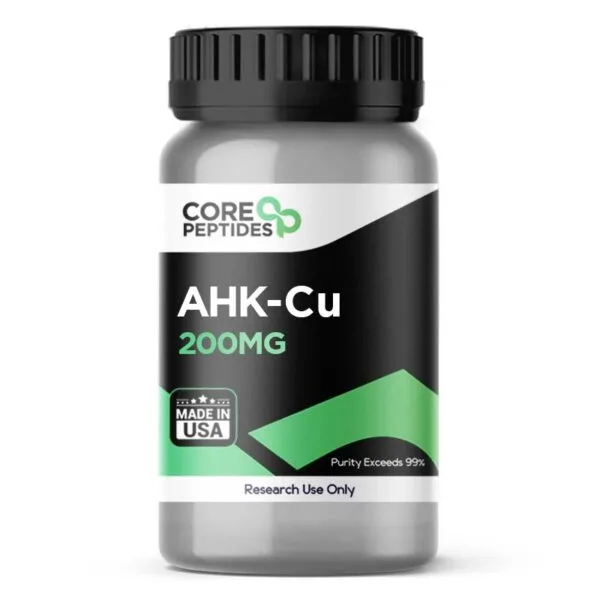
AHK-Cu (200mg)
$200.00
AHK-Cu is a peptide composed of amino acids alanine, histidine, and lysine, with a copper ion coordinated by various parts of these three amino acids.(1) This peptide appears to be naturally present in the bloodstream and has been suggested as a potential element in regulating the growth, development, and apoptosis of vascular endothelial cells.
Size: 200mg
Contents: AHK-Cu
Form: Lyophilized powder
Purity: >99%
SKU: P-AHK-CU
Description
AHK-Cu
AHK-Cu is a peptide composed of amino acids alanine, histidine, and lysine, with a copper ion coordinated by various parts of these three amino acids.(1) This peptide appears to be naturally present in the bloodstream and has been suggested as a potential element in regulating the growth, development, and apoptosis of vascular endothelial cells.
AHK-Cu, also known as copper AHK, has been researched for its potential in hair growth and supporting skin tissue integrity. This peptide has been suggested to exhibit its potential primarily on fibroblasts, responsible for maintaining and growing the extracellular matrix (ECM) components surrounding the cells. Fibroblasts also appear to secrete various biological substances, including the Vascular Endothelial Growth Factor (VEGF), which is suggested to promote the formation of new blood vessels.
The copper ion in AHK-Cu is suggested to be involved in enzyme activity related to collagen and elastin synthesis. These two proteins are critical components of the extracellular matrix and play a role in maintaining the skin tissues’ structural integrity. Copper ions are also suggested to exhibit antioxidant properties.
Chemical Makeup(2)
Molecular Formula: C15H25CuN6O4
Molecular Weight: 416.9 g/mol
Other known titles: ALA-HIS-LYS-CU, L-Alanyl-ĪŗN-L-histidyl-ĪŗN,ĪŗN3-L-lysinato(2-)]copper Monohydrochloride
Research and Clinical Studies
AHK-Cu Peptide and Antioxidative Potential
AHK-Cu is posited to have potent antioxidant qualities, primarily due to its distinct amino acid structure. Based on the antioxidative properties of this peptide, studies have suggested its potential in amplifying hair follicle size, which may increase growth. This peptide has been the focus of numerous in-vitro investigations, particularly concerning its role in hair growth. These studies uniformly suggest AHK-Cu’s potential to foster hair follicle development. In addition to hair growth, AHK-Cu’s scope of application may extend to cell aging, wound healing, and other areas, according to researchers. They posit its potential role in boosting dermal cell multiplication and survival, both of which are essential in collagen production. Collagen is a vital element for maintaining skin cell turnover and function, and the increased cell activity provided by AHK-Cu may facilitate this process.(3)
AHK-Cu Peptide and Hair Follicle Development
Researchers posit that the tripeptide AHK-Cu may potentially stimulate the proliferation of dermal fibroblasts, a type of cell that produces substances like vascular endothelial growth factor (VEGF), which are considered to be crucial for the growth of blood vessels. AHK-Cu may also reduce the secretion of transforming growth factor-beta1 by dermal fibroblasts.
In a recent study,(4) the potential of AHK-Cu on hair growth was investigated. It was suggested that the peptide may promote the elongation of hair follicles and the proliferation of dermal papilla cells (DPCs), which are specialized fibroblasts with a potential to increase the growth and development of hair follicles. Moreover, the authors suggested that the presence of AHK-Cu may have reduced the number of apoptotic dermal papilla cells. Further analysis suggested that the peptide may have increased the ratio of Bcl-2/Bax, and potentially decreased cleaved caspase-3 and PARP levels, two markers of cell death. The Bcl-2/Bax ratio is suggested to play a potential role in the regulation of apoptosis. Bcl-2 is posited as an anti-apoptotic protein that apparently inhibits cell death, while Bax is suggested to be a pro-apoptotic protein that promotes cell death. Thus, a higher Bcl-2/Bax ratio is posted as a predominance of Bcl-2, which may inhibit apoptosis and apparently promotes cell survival. Ultimately, the researchers suggested that AHK-Cu āstimulated the elongation of [ā¦] hair follicles [ā¦] and the proliferation of DPCs in vitro.ā Based on these observations, the researchers commented, āThe present study proposed that AHK-Cu promotes the growth of […] hair follicles, and this stimulatory effect may occur due to stimulation of the proliferation and the preclusion of the apoptosis of DPCs.ā(4). Other researchers delving into this trial also noticed that the peptide may have interacted with VEGF and Transforming Growth Factor Beta 1 (TGF-β1). TGF-β1 is researched for its role in cell proliferation, differentiation, and apoptosis. It is posited to be involved in several cellular processes, including the regulation of immune responses and wound healing. By potentially downregulating TGF-β1, AHK-Cu may alter these cellular processes, possibly affecting cell growth and the immune response at a cellular level. On the other hand VEGF is researched for its role in angiogenesis, the formation of new blood vessels from pre-existing vessels. The upregulation of VEGF by AHK-Cu might imply an enhanced potential for angiogenesis, which could influence nutrient and oxygen supply at the cellular level.(5) VEGF specifically is posited to foster the development of blood vessels surrounding hair follicles. This action potentially aids in delivering nutrients and oxygen to the hair follicles, thereby supporting hair growth.
AHK-Cu Peptide and Alopecia Research
The study examined the potential of two formulations containing growth factors and peptides such as vascular endothelial growth factor, basic fibroblast growth factor, insulin-like growth factor-1, keratinocyte growth factor, and copper tripeptide 1 and related peptides such as AHK-Cu, suspended in a sterile vehicle. The experiment investigated the potential cytotoxicity of these factors using in vitro keratinocyte and fibroblast cell assays. The formulations were also investigated for their potential for hair growth and hair follicle viability in cases of secondary alopecia.(1)
The authors suggested that both formulations appeared to produce a positive response regarding hair growth in the animals. The formulations also were posited to be impactful when tested alongside agents that may be associated with alopecia. Researchers Rinky Kapoor et al. state, āResults seem encouraging enough to warrant a trial in […] secondary alopecia.ā (1)
AHK-Cu Peptide and Skin Tissue Integrity
Preliminary lab studies have suggested that the core molecule of the peptide, AHK, may stimulate the growth of fibroblast cells and the production of collagen. Notably, AHK appears to improve the survival and multiplication of dermal fibroblasts, which are researched for their potential for generating vital skin proteins like collagen. In experiments with normal dermal fibroblasts, AHK was observed to apparently boost both cell growth and viability, alongside enhancing collagen type I production. This conclusion was drawn by measuring collagen type I levels produced by fibroblasts in a cell culture following exposure to varying concentrations of AHK. The studies indicated that AHK’s presence may have raised collagen type I production, with a threefold increase compared to the control group. These results imply that AHK could potentially rejuvenate the extracellular matrix and contribute to skin function.
References
- Kapoor R, Shome D, Vadera S, Kumar V, Ram MS. QR678 & QR678 Neo Hair Growth Formulations: A Cellular Toxicity & Animal Efficacy Study. Plast Reconstr Surg Glob Open. 2020 Aug 25;8(8):e2843. doi: 10.1097/GOX.0000000000002843. PMID: 32983753; PMCID: PMC7489598. https://www.ncbi.nlm.nih.gov/pmc/articles/PMC7489598/
- AHK-Cu, ChemBK. https://www.chembk.com/en/chem/AHK-Cu
- Kecel-Gunduza, S., Kocb, E., Bicaka, B., Kokcub, Y., Ozela, A. E., & Akyuzc, S. (2020). IN SILICO ANALYSIS FOR CHARACTERIZING THE STRUCTURE AND BINDING PROPERTIES OF ALA-HIS-LYS (AHK) TRIPEPTIDE. The Online Journal of Science and Technology-July, 10(3).
- Pyo HK, Yoo HG, Won CH, Lee SH, Kang YJ, Eun HC, Cho KH, Kim KH. The effect of tripeptide-copper complex on human hair growth in vitro. Arch Pharm Res. 2007 Jul;30(7):834-9. doi: 10.1007/BF02978833. PMID: 17703734. https://pubmed.ncbi.nlm.nih.gov/17703734/
Reviews (0)
Be the first to review “AHK-Cu (200mg)” Cancel reply
Shipping and Delivery
MAECENAS IACULIS
Vestibulum curae torquent diam diam commodo parturient penatibus nunc dui adipiscing convallis bulum parturient suspendisse parturient a.Parturient in parturient scelerisque nibh lectus quam a natoque adipiscing a vestibulum hendrerit et pharetra fames nunc natoqueĀ dui.
ADIPISCING CONVALLIS BULUM
- Vestibulum penatibus nunc dui adipiscing convallis bulum parturient suspendisse.
- Abitur parturient praesent lectus quam a natoque adipiscing a vestibulum hendre.
- Diam parturient dictumst parturient scelerisque nibh lectus.
Scelerisque adipiscing bibendum sem vestibulum et in a a a purus lectus faucibus lobortis tincidunt purus lectus nisl class eros.Condimentum a et ullamcorper dictumst mus et tristique elementum nam inceptos hac parturient scelerisqueĀ vestibulum amet elit ut volutpat.
Related products
ACE-031 Peptide (1mg)
$170.00
ACE-031 1 mg is a research-grade lyophilized protein peptide engineered for high-purity laboratory applications. Each vial contains 1 mg of HPLC-verified ACE-031, third-party tested to guarantee over 99% purity and manufactured in the USA under strict standards. Formulated specifically for research investigating myostatin signal neutralization, ActRIIB decoy receptor binding, and muscle growth regulation pathways, this product is strictly intended for research use only.
CJC-1295 NO DAC (Mod GRF 1-29) (5mg)
$40.00
CJC-1295 NO DAC (Mod GRF 1-29) 5mg is a premium, high-purity (\ge99% HPLC-verified) synthetic peptide derived from natural Growth Hormone-Releasing Hormone (GHRH). Engineered with four target amino acid substitutions (positions 2, 8, 15, and 27), it offers superior resistance against DPP-IV enzymatic degradation while maintaining a natural, short-acting pulsatile signaling profile. Supplied as a sterile, lyophilized powder strictly for scientific laboratory and in vitro research applications.
KPV Peptide (4mg)
$40.00
KPV Peptide 4 mg provides a high-purity, laboratory-verified lyophilized peptide manufactured under strict quality control standards in the USA. Formulated with 4 mg of pure KPV (Lysine-Proline-Valine)āthe C-terminal tripeptide fragment of alpha-melanocyte-stimulating hormone (\alpha\text{-MSH})āthis compound is widely utilized in gastroenterology, immunology, and dermatology research investigating inflammatory bowel disease (IBD) suppression, antimicrobial signaling, and NF-\kappa\text{B} pathway downregulation.
Key Specifications
Ā Active Compound: KPV (Lysine-Proline-Valine / \alpha\text{-MSH}_{11-13})
Ā Chemical Formula: \text{C}_{16}\text{H}_{30}\text{N}_{4}\text{O}_{4}
Ā Concentration: 4 mg per vial
Ā Purity Standard: Exceeds 99% (Third-Party HPLC Verified)
Ā Formulation: Sterile Lyophilized Powder
Ā Origin: Manufactured in USA
Ā Classification: Research Use Only
Primary Research Applications
Ā Gastrointestinal Anti-Inflammatory Modulation: KPV is extensively studied in intestinal inflammation models for its ability to penetrate mucosal epithelial cells and inhibit nuclear factor kappa B (NF-\kappa\text{B}) translocation, reducing colonic tissue damage.
Ā Antimicrobial & Anti-Fungal Activity: Evaluated in cellular microbiology models for direct antimicrobial properties against pathogen strains, including Candida albicans and Staphylococcus aureus.
Ā Dermatological & Tissue Repair: Investigated in wound healing and inflammatory skin condition models to suppress pro-inflammatory cytokine expression (\text{IL-6}, \text{TNF-}\alpha) without inducing melanogenesis.
MOTS-C 10mg
$115.00
Buy high-purity MOTS-c 10 mg lyophilized research peptide (ā„99% purity). MOTS-c is a 16-amino acid mitochondrial-derived peptide that activates the AMPK pathway to regulate metabolic homeostasis, glucose utilization, and cellular stress resistance. Ideal for research in metabolic health, exercise adaptation, and longevity science. Fast shipping and lab-tested quality guaranteed.
NAD+ Peptide (750 mg)
$250.00
NAD+ Peptide 750 mg provides a high-purity, laboratory-verified lyophilized coenzyme manufactured under strict quality control standards in the USA. Formulated with 750 mg of pure Nicotinamide Adenine Dinucleotide (\text{NAD}^+) per vial, this essential coenzyme is widely utilized in cellular biology, metabolic pathways, and anti-aging research examining mitochondrial oxidative phosphorylation, sirtuin enzyme activation, PARP-mediated DNA repair, and intracellular redox homeostasis.
Key Specifications
Ā Active Compound: \text{NAD}^+ (Nicotinamide Adenine Dinucleotide)
Ā Chemical Formula: \text{C}_{21}\text{H}_{27}\text{N}_{7}\text{O}_{14}\text{P}_{2}
Ā Concentration: 750 mg per vial
Ā Purity Standard: Exceeds 99% (Third-Party HPLC Verified)
Ā Formulation: Sterile Lyophilized Powder
Ā Origin: Manufactured in USA
Ā Classification: Research Use Only
Primary Research Applications
Ā Mitochondrial ATP Production & Electron Transport: Functions as a critical electron acceptor in glycolysis and the citric acid cycle, making it essential for research into cellular respiration kinetics and energy production efficiency.
Ā Sirtuin (SIRT1āSIRT7) & PARP Activation: Serves as a required substrate for sirtuins and poly(ADP-ribose) polymerases (PARPs), enabling investigation into genomic stability, chromatin remodeling, and longevity signaling pathways.
Ā Cellular Senescence & Metabolic Homeostasis: Widely applied in age-related research models measuring declining pool concentrations, oxidative stress mitigation, and systemic metabolic function restoration.
Pinealon Peptide (20mg)
$75.00
Pinealon Peptide 20 mg is a research-grade lyophilized tripeptide engineered for high-purity laboratory applications. Each vial contains 20 mg of HPLC-verified Pinealon, third-party tested to guarantee over 99% purity and manufactured in the USA under strict standards. Formulated specifically for research investigating neuroprotection, pineal gene expression, and cognitive function optimization, this product is strictly intended for research use only.
Receptor Grade IGF-1 LR3 (1mg)
$150.00
IGF-1 LR3 Receptor Grade 1 mg provides a high-purity, laboratory-verified lyophilized recombinant peptide manufactured under strict quality control standards in the USA. Formulated with 1 mg of pure Long \text{R}^3 Insulin-like Growth Factor-1, this modified analog features an arginine substitution at position 3 and a 13-amino-acid N-terminal extension. Specifically designated as receptor grade, this compound exhibits significantly reduced binding affinity for IGF binding proteins (IGFBPs), allowing researchers to study prolonged, uninhibited receptor-ligand interactions and cellular proliferation dynamics.
Key Specifications
Ā Active Compound: IGF-1 LR3 (Long Arginine 3 IGF-1)
Ā Grade: Receptor Grade
Ā Concentration: 1 mg per vial
Ā Purity Standard: Exceeds 99% (Third-Party HPLC Verified)
Ā Formulation: Sterile Lyophilized Powder
Ā Origin: Manufactured in USA
Ā Classification: Research Use Only
Primary Research Applications
Ā IGFBP Resistance & Extended Half-Life: The structural modification drastically lowers binding to IGF-binding proteins, enabling researchers to observe sustained activation of the IGF-1 receptor (IGF-1R) without rapid metabolic inactivation.
Ā Cellular Proliferation & Protein Synthesis: Widely applied in vitro to study MAPK/ERK and PI3K/Akt/mTOR signaling pathways involved in cell growth, myogenesis, and nutrient transport regulation.
Ā Hyperplasia & Tissue Culture Assays: Utilized in research models measuring satellite cell activation, skeletal muscle fiber recruitment, and metabolic shift mechanics.
Semaglutide 5 mg
$70.00
Semaglutide 5 mg is a research-grade lyophilized peptide engineered for high-purity laboratory applications. Each vial contains 5 mg of HPLC-verified Semaglutide, third-party tested to guarantee over 99% purity and manufactured in the USA under strict quality standards. Formulated specifically for research investigating GLP-1 receptor activation, glucose-dependent insulin secretion, gastric emptying regulation, and metabolic homeostasis pathways, this product is strictly intended for research use only.


Reviews
There are no reviews yet.