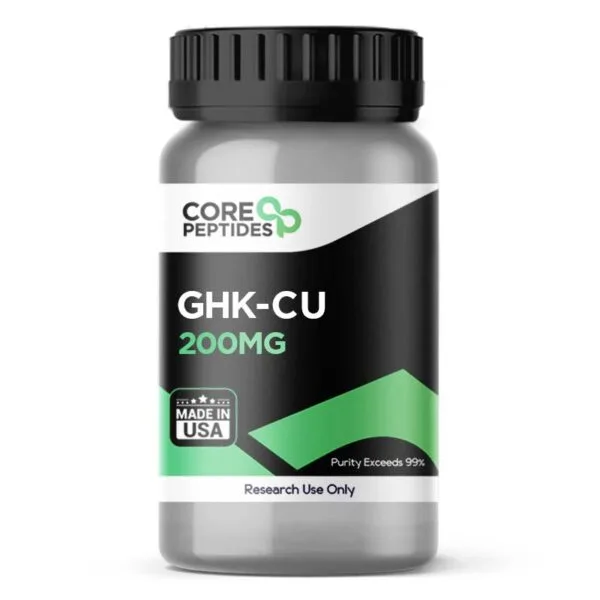
GHK-Cu (200mg)
$197.00
Size: 200mg
Contents: GHK-Cu
Form: Lyophilized powder
Purity: >99%
SKU: P-GHK-CU
FREE Shipping on $200+ orders
| Quantity | Discount | Price |
|---|---|---|
| 5 – 8 | 5% | $187.15 |
| 9 + | 10% | $177.30 |
GHK-Cu Peptide
GHK-Cu 20mg is a naturally occurring complex molecule composed of a tripeptide called GHK (made up of glycine, histidine, and lysine amino acids) bound to a copper ion. The copper ion appears to stabilize and deliver GHK to cells. Research suggests that GHK-Cu may play a potentially essential role in restoring damaged tissues, wound repair, and may support immune response. These hypotheses have sprung from its perceived potential to stimulate the production of collagen, elastin, and glycosaminoglycans, crucial intercellular matrix components.
In addition to its potential on the intercellular matrix, GHK-Cu may also have antioxidant and anti-inflammatory characteristics that may protect cells from damage caused by free radicals.
Chemical Makeup
Molecular Formula: C14H23CuN6O4
Molecular Weight: 340.38 g/mol
Other Known Titles: Cu-GHK, Copper tripeptide-1, 6BJQ43T1I9
Research and Clinical Studies
GHK-Cu and Collagen Synthesis
Studies suggest that GHK-Cu may stimulate collagen synthesis and induce in situ tissue recovery. The researchers suggest that these actions may be due to “the presence of a GHK triplet in the alpha 2(I) chain of type I collagen”.(1) More specifically, the tripeptide sequence composed of glycine, histidine, and lysine, abbreviated as Gly-His-Lys, may be derived during the breakdown of collagen through hydrolysis. This breakdown is typically associated with the disintegration of collagen fibers, frequently resulting from either tissue damage or the natural degradation process. It is proposed that this specific peptide sequence may have a significant impact on cellular communication processes, specifically targeting fibroblasts. Fibroblasts are specialized cells deemed essential in producing new collagen fibers, vital components for structural support in various tissues.
The interaction between the Gly-His-Lys peptide and fibroblasts is believed to potentially initiate a cascade of biological events leading to the synthesis of collagen, thereby playing a potential role in the mechanisms of tissue repair and regeneration. This process of collagen synthesis by fibroblasts may be critical to contribute to the overall restoration and healing of damaged tissues. One study, lasted a month, reported that GHK-Cu might stimulate type 1 collagen production in clinical settings.(2) The scientists compared the potential of GHK-Cu to other peptides and vitamin C and vitamin A derivatives on photodamaged skin. The research primarily investigated the potential action of the peptide on dermal procollagen synthesis, keratinocyte proliferation, differentiation, and cutaneous inflammation. The peptide appeared to improve all indicators, and the researchers reported an apparent increase in skin thickness, elasticity, and hydration.
Another study explored the potential interaction between GHK-Cu and hyaluronic acid (HA) on collagen synthesis, particularly focusing on their potential collaborative actions in dermal fibroblasts and an ex-vivo skin model.(3) HA is portrayed as a significant component of skin cells, noted for its moisture-binding potential and actions on cell proliferation and inflammation, with different molecular weights (LMW and HMW) showing distinct biological activities. The experimental setup involved exposure of dermal fibroblasts with various combinations of GHK-Cu and HA, measuring the synthesis of collagen types I, IV, and VII. It was suggested that certain combinations, particularly at a GHK-Cu to LMW HA ratio of 1:9, appeared to have significantly boosted the synthesis of collagen IV—more so than when either compound was studied independently. This suggests a potential synergistic action between GHK-Cu and HA, specifically in enhancing collagen IV levels. The synergy might arise from the combined action of GHK-Cu in stimulating glycosaminoglycan production, promoting collagen synthesis, and HA’s role in reducing collagen degradation by scavenging reactive oxygen species and inhibiting matrix metalloproteinases. The research highlights that the molecular weight of HA and the ratio of GHK-Cu to HA may be crucial in maximizing this action, with optimal results observed at specific ratios. Further studies employing an ex-vivo skin model supported these findings, suggesting a notable increase in collagen IV synthesis at the dermal-epidermal junction when exposed to the optimized GHK-Cu and LMW HA mixture. This action was visually corroborated through increased fluorescence intensity in immunofluorescence assays, indicating higher collagen IV content.
GHK-Cu and Wound Infection
Both animal and clinical studies have hypothesized that GHK-Cu may reduce inflammation and the risk of infection in wounds. One murine study investigated the potential of GHK-Cu on ischemic open wounds.(4) The researchers reported, “On days 6, 10, and 13, tripeptide-copper complex-treated wounds contained significantly lower concentrations of TNF-alpha and MMP-2 and MMP-9 than control wounds.” Tumor necrosis factor-alpha (TNF-alpha), a cytokine involved in systemic inflammation, along with matrix metalloproteinase-2 (MMP-2) and matrix metalloproteinase-9 (MMP-9) — enzymes that break down extracellular matrix proteins — might potentially influence both the inflammatory processes and the remodeling of tissues. This suggests that GHK-Cu, a copper complex recognized for its healing capacities, might have a role in reducing inflammation and preventing tissue breakdown in models of ischemic wounds, where blood flow restriction potentially causes tissue damage.
A clinical trial that involved GHK-Cu in addition to standard wound care also reported an apparently reduced risk of infection compared to standard processes alone.(5) The study was conducted on models of diabetic neuropathic ulcers, and the rate of infections was only 7% in the GHK-Cu models compared to 34% in the control models.
GHK-Cu and Wound Healing
Studies in rabbits report that GHK-Cu has been tested regarding its potential in wound healing and laser exposure at different intensities.(6) The results were compared to control wounds without intervention. Wounds were observed daily, and biopsies were taken weekly for four weeks to evaluate the inflammation rate and neovascularization. The GHK-Cu and high-intensity laser groups appeared to have a shorter average time for healing and greater neutrophil and vessel counts. There was an apparently shorter median time for the first observable granulation tissue and an apparently faster filling of an open wound with granulation tissue compared to the control group. Granular tissue is composed of newly formed connective tissue and minuscule blood vessels that appear on wound surfaces as part of the healing process. It is suggested that there might be a link between the emergence of this tissue and heightened activity of antioxidant enzymes. These enzymes are proteins that assist in shielding cells from the harmful action of oxidative stress, a process where cell components are damaged due to the presence of unstable molecules known as free radicals. Furthermore, there is a potential enhancement in vascular development observed in these scenarios. This vascular development is considered vital for transporting essential nutrients and oxygen to the damaged area, thereby facilitating the repair of tissue.
The previously mentioned study on rats with open ischemic wounds also reported an apparent decrease in wound area of the GHK-Cu group that was greater compared to the control group on days 3 to 5, 6 to 9, and 11 to 13.(4)
Similarly, the clinical study on models of diabetic neuropathic ulcers reported that GHK-Cu, combined with standard wound care, appeared more impactful for wound closure than standard care alone.(5) The apparent closure rate was three times faster than standard care. The researchers also suggested that “The enhancement of wound closure was more pronounced (median of 89.2% compared with -10.3% for vehicle; p < 0.01) in larger (greater than 100 mm(2) initial area at study entry) plantar ulcers caused by the failure of this size of ulcer to respond adequately to standardized wound care.”
In research involving both standard murine models and those adapted to mimic diabetic conditions, wound dressings composed of collagen and infused with GHK were observed to potentially enhance wound healing.(7) The observations suggest that by the conclusion of the third week, wounds exposed to dressings containing biotinylated GHK (a tripeptide with skin regenerative properties) nearly achieved full closure, registering at 99.39%. This is potentially a significant enhancement compared to the 69.49% closure rate observed with control dressings lacking this modification. Further analysis indicated that the wounds exposed to GHK might have shown elevated levels of glutathione and ascorbic acid. These are considered critical antioxidants for their potential roles in facilitating tissue repair by protecting cells from oxidative stress. There was also a tentative observation of increased epithelialization, a process essential for the regeneration of the skin’s outer layer, in these experimental conditions. Apart from the enhanced activity of fibroblasts, which are pivotal in collagen synthesis, tissue repair, and regeneration, there was also noted a potential rise in mast cell activation. Mast cells are important for mediating inflammatory responses, which are deemed crucial during the initial phases of wound healing.
GHK-Cu and Active Radicals
Photodamage of tissues such as the skin involves the formation of reactive oxygen species (ROS), reactive nitrogen species (RNS), and reactive carbonyl species (RCS), which may induce damage to proteins, DNA, and lipids. Studies suggest that the amino acid sequence in GHK-Cu may have anti-RCS potential against radicals such as 4-hydroxynoneal, acrolein, malondialdehyde, and others.(8) Furthermore, it may potentially prevent protein glycation. Moreover, researchers have suggested that GHK-Cu may have potential action in reducing iron release from ferritin. Ferritin is a lipid peroxidation catalyst, and GHK-Cu may help to reduce the formation of iron complexes in damaged tissues and thus decrease inflammation. One study suggested an 87% decrease in iron release with the help of GHK-Cu to lower oxidation in damaged tissues.(9)
GHK-Cu may also reduce the production of reactive oxygen species and inflammatory cytokines while increasing the activity of antioxidant enzymes. This was proposed by an animal study investigating the potential of GHK-Cu on lipopolysaccharide-induced lung inflammation in mice.(10) The peptide was suggested to suppress the activation of NF-κB and p38 MAPK signaling pathways associated with inflammation. This might potentially lead to reduced infiltration of inflammatory cells in the lungs of mice with lung damage and lower levels of TNF-1 and IL-6 production to minimize damage.
Further studies also suggest that the amino-acid sequence of GHK-Cu may have an antioxidative potential on ROS, such as hydroxyl radicals, and it may be even stronger than generic antioxidative peptides.(12)
GHK-Cu and Wrinkles in Skin Tissue Models
GHK-Cu has been suggested to host potential for improving experimental models of disturbed skin topography, such as wrinkles and fine lines. One study posited that a GHK-Cu possibly reduces visible bioindicators, improving skin laxity, and clarity. The peptide apparently also reduced the depth of wrinkles while potentially increasing skin density and thickness after 12 weeks of experimentation in skin cell models with varying degrees of photodamage.(13)
Another investigation focused on the actions of GHK-Cu compared to a control compound and vitamin K. Over a period of 12 weeks, the GHK-Cu ostensibly performed better than the controls in reducing epidermal wrinkles. The peptide may also have increased skin density and thickness.(14)
In a separate 12-week study in mild to advanced photodamage, GHK-Cu seemingly improved skin attributes such as laxity, clarity, and firmness. This peptide was also associated with a reduction in coarse wrinkles, and mottled pigmentation. Additionally, the peptide apparently stimulated dermal keratinocyte proliferation, as evidenced by histological analysis of biopsies.

Related products
ACE-031 (1mg)
- Lyophilized: 2–8°C (refrigerated)
- Reconstituted: Refrigerate and use within recommended research timeframe Stability: Stable when stored under proper conditions
Reviews
There are no reviews yet.