
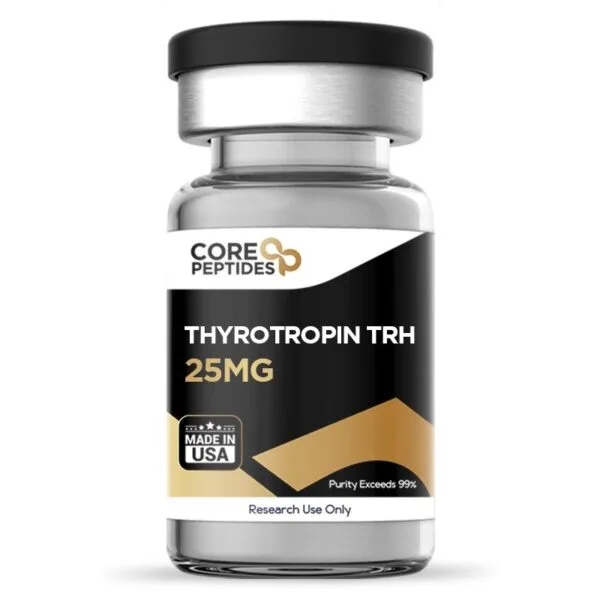
Thyrotropin TRH (25mg)
$73.00
Size: 25mg
Contents: Thyrotropin (25mg)
Form: Lyophilized powder
Purity: >99%
SKU: P-THYROTRP-25
FREE Shipping on $200+ orders
| Quantity | Discount | Price |
|---|---|---|
| 5 – 8 | 5% | $69.35 |
| 9 + | 10% | $65.70 |
Thyrotropin Peptide
Thyroid hormones are considered to be growth and metabolism regulators. In order to maintain the synchrony of these regulating mechanisms and hemostasis, hormones released by the hypothalamus are called Thyrotropin-releasing hormone (TRH).(1) This hypothalamic hormone is posited to play a crucial role in the feedback loop that regulates thyroid function. Scientists consider the main function of Thyrotropin-releasing hormone (TRH) to be the stimulation of the pituitary gland to release Thyroid-Stimulating Hormone (TSH) which in turn plays a role in the maintenance of the levels of thyroid hormones.(2) More specifically, TSH acts directly on the thyroid gland to promote the synthesis and release of thyroid hormones, primarily thyroxine (T4) and triiodothyronine (T3). While TRH is an endogenous compound, a synthetic peptide was developed with the hopes of simulating TRH characteristics and is known as Thyrotropin, or Protirelin.(3)
Overview
Thyrotropin is the synthetic analogue of the endogenous peptide hormone Thyrotropin-releasing hormone.(3) Structurally analogous to TRH, Thyrotropin is a tripeptide composed of three amino acid residues connected in a sequential form.(3) Researchers consider Thyrotropin to potentially function via binding to the thyrotropin-releasing hormone (TRH) receptors TRH-1 and TRH-2.(4)(5)(6) This interaction stimulates a cascade of biochemical events within the cell, highlighting the significant impact of these hormonal interactions on overall endocrine system function.
On binding with these receptors, which are mediated by G proteins, a possible cascade of signals may be generated. First, a hydrolase enzyme may be activated, which in turn may cause a breakdown of an existing compound, producing inositol. Research indicates that Inositol may bind with another receptor, a calcium channel, thereby resulting in possible increased cellular levels of calcium which may activate protein kinase C, potentially leading to elevated phosphorylation of secondary messenger enzymes.
All these signals carry the collective potential to modify gene expression in the nucleus of a cell, which may transduce the TRH binding signal to stimulate the pituitary gland to release TSH, thus regulating thyroid hormone production in the thyroid gland. This detailed mechanism is essential for maintaining metabolic balance and responding to physiological demands.
Specifications:
Molecular Formula: C16H22N6O4
Molecular Weight: 362.39 g/mol
Other Known Titles: Protirelin
Research and Clinical Studies
Thyrotropin Releasing Peptide and The Central Nervous System
Studies have investigated the potential of Thyrotropin-releasing hormone within the central nervous system, particularly its potential to modulate neurotransmitter systems, focusing on its actions in superfused rat hippocampal slices subjected to potassium-induced depolarization.(7) Although specific mechanisms are not fully delineated, Thyrotropin-releasing hormone seems to exert notable actions under certain conditions. The experiments demonstrated that while Thyrotropin-releasing hormone did not modify basal levels of glutamate or aspartate, it significantly inhibited their release during neuronal activation triggered by potassium. This suggests that Thyrotropin-releasing hormone may play a role in controlling the release of excitatory neurotransmitters during heightened neuronal activity, indicative of a modulatory capacity that could be relevant in conditions of neural excitability such as seizures or neurodegenerative states. The observed actions of Thyrotropin-releasing hormone might be mediated through its interaction with high-affinity receptors associated with G-protein coupled receptor pathways, which involve complex intracellular signaling cascades including calcium mobilization. The inhibition of glutamate and aspartate release appears to be calcium-dependent, raising the possibility that Thyrotropin-releasing hormone might influence calcium channels or the associated release machinery. Interestingly, the inhibitory action on neurotransmitter release did not follow a straightforward response curve, suggesting intricate receptor interactions or the influence of additional regulatory mechanisms
Thyrotropin Releasing Peptide and Amyotrophic Lateral Sclerosis
Researchers are considering the potential function of Thyrotropin in Amyotrophic Lateral Sclerosis (ALS).(8) Researchers suggest that Thyrotropin may act as a neuromodulator during the hyperactivity of the hypothalamic nervous system, which may assert some mitigation of Amyotrophic Lateral Sclerosis (ALS) symptoms.(9)
Thyrotropin Releasing Peptide and Behavioral Research
Initial clinical studies conducted to assess the potential of the peptide were somewhat hindered as researchers considered the peptide might not be able to cross the blood brain barrier.(10) Scientists consider the blood brain barrier to be one of the most difficult membranes to cross as it is composed of closely spaced cells in order to prevent toxic substances from crossing over and reaching the brain.(11)
In this study,(10) the peptide was presented into the spinal theca (or cerebrospinal fluid). Eight test subjects with depressive symptoms were enrolled in a double-blind clinical trial study. Upon analysis, it was observed by the researchers that five out of the eight subjects exhibited an apparent 50% or more reduction in depressive behavior. It is suggested that the peptide’s modes of action could potentially be linked to its interactions with certain neurotransmitter systems. Thyrotropin-releasing peptide is hypothesized to affect the pathways of serotonin and dopamine, both of which play significant roles in regulating mood. These actions might be facilitated through TRH receptors, which are prominently found in areas of the brain such as the amygdala and hippocampus, key sites for behavioral regulation. Additionally, it is conceivable that Thyrotropin-releasing peptide could influence these neurotransmitter systems by modifying their synthesis, the release of neurotransmitters, or their reuptake at the points where neurons communicate, known as synapses. Furthermore, Thyrotropin-releasing peptide is reported to exhibit actions on behavior that are contingent upon the existing neural or physiological conditions of the individual. For example, Thyrotropin-releasing peptide may have the capacity to restore balance to both overactive and underactive neural conditions by altering neurotransmitter levels appropriately. This hypothesis is supported by the observations of behavioral enhancements noted in clinical studies like this one, where changes in mood are described as quick yet short-lived, indicating a temporary recalibration of neural processes rather than a permanent alteration. This dynamic response could be indicative of Thyrotropin-releasing peptide’s capacity to adjust to and moderate varying neurological states.
In another study,(12) 44 subjects were presented with the “Thyrotropin test”. Out of the 44 test subjects, 19 exhibited an apparently blunted response to the test, indicating possible hypothyroidism, whereas 6 exhibited an apparently higher response to the test. Five of these subjects with a high augmented response were reported to naturally produce antithyroid antibodies. Through this study, researchers posited that the peptide may serve to indicate improper functioning of the thyroid gland, or determine any possible behavioral depressors.
Thyrotropin Releasing Peptide and Blood Pressure
In one clinical study which sought to conduct diagnostic tests on test subjects, it was suggested by the researchers that the peptide might contribute to an elevation in blood pressure rate. In this study,(13) eight subjects were examined one day before, the day after, and four weeks after heart surgery. All these subjects were given Thyrotropin. While the peptide did not appear to induce any significant changes in the levels of heart rate and thyroid hormones, the blood pressure rates reportedly increased on all three days. These results indicate that Thyrotropin may lead to increased blood pressure rates, and hence it is important for the clinical researcher to be aware of the subjects’ pre-existing heart conditions when it comes to peptide experimentation.
Researchers have further experimented with the peptide to investigate its specific mechanisms.(14) When the preoptic suprachiasmatic nucleus (POS) and the medial preoptic nucleus (pom) in test models were exposed to Thyrotropin, there was a 7% increase in blood pressure and a 19% increase in heart rate observed. The response in these areas was noted to be more pronounced compared to other regions, suggesting a possible localized action of Thyrotropin within these nuclei. Interestingly, different responses were recorded in other areas of the hypothalamus, such as the posterior hypothalamic nucleus (NHP), where Thyrotropin not only increased heart rate but also blood pressure, whereas only heart rate increases were observed in the anterior (NHA) and dorsomedial (NDM) hypothalamic nuclei. Preliminary exploration into the underlying mechanisms suggests that these cardiovascular changes could potentially be mediated by a mix of autonomic nervous system regulations. It is posited that inhibition of the parasympathetic nerves could contribute to the heart rate increases in the POSregion. Conversely, in the NHP area, the response to Thyrotropin is thought to be mediated by adrenal catecholamine release, indicating a role of adrenal hormones in these actions. Further, the study indicates that activation of the cardiac sympathetic nerves may play a role in the NHA region, as responses to Thyrotropin were not prevented by either methylatropine preexposure or adrenalectomy. This observation suggests a potential mechanism whereby Thyrotropin acts through pathways independent of adrenal involvement or parasympathetic inhibition. It is also notable that Thyrotropin’s impact was not uniform across all tested areas, with a decrease in both blood pressure and heart rate observed in a specific pom region (A7050–7400).





Reviews
There are no reviews yet.