
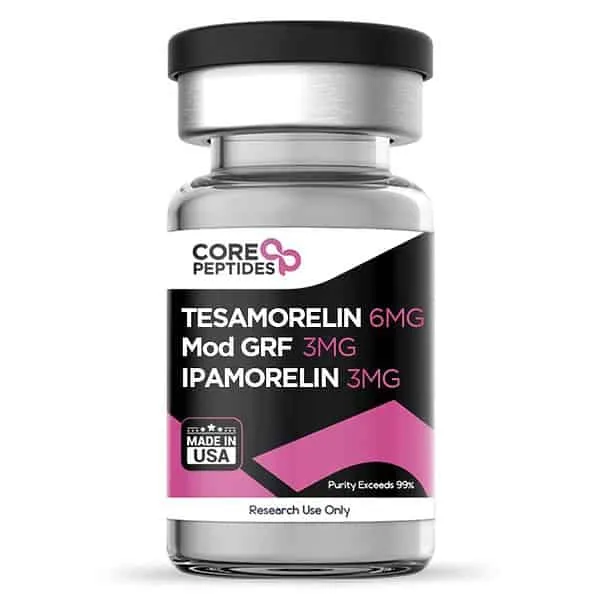
Tesamorelin & CJC-1295 (Mod GRF 1-29) & Ipamorelin Blend (12mg)
$117.00
Size: 12mg
Contents: Tesamorelin (6mg) & CJC-1295 (Mod GRF 1-29) (3mg) & Ipamorelin (3mg)
Form: Lyophilized powder
Purity: >99%
SKU: TESA-MOD-GRF-IPA-12MG
FREE Shipping on $200+ orders
| Quantity | Discount | Price |
|---|---|---|
| 5 – 8 | 5% | $111.15 |
| 9 + | 10% | $105.30 |
Tesamorelin & CJC-1295 (Mod GRF 1-29) & Ipamorelin Peptide Blend
Tesamorelin & CJC-1295 (Mod GRF 1-29) & Ipamorelin are all synthetic peptides which, albeit via different proposed mechanisms, have exhibited potential to stimulate growth hormone (GH) synthesis and secretion.
Tesamorelin, a synthetic analogue of the growth hormone-releasing hormone (GHRH), appears to act by specifically stimulating the production and release of endogenous growth hormone (GH) due to its potential binding affinity for GHRH receptors. Structurally, Tesamorelin is a chain of 44 amino acids, containing a sequence that bears resemblance to GHRH. Intriguingly, modifications have been introduced to Tesamorelin to possibly fortify its defense against enzymatic breakdown. For instance, its C-terminus showcases a trans-3-hexenoic acid group alteration, a change sometimes referred to as an omega-amino acid modification, which is suggested to bolster the peptide’s resilience to enzymatic degradation. Further, Tesamorelin’s N-terminus is adorned with an acetyl group (CH₃CO-), a modification that might further amplify the molecule’s stability and biological efficacy. Consequently, this peptide garners the designation N-(trans-3-hexenoyl)-[Tyr1]hGRF(1–44)NH2 acetate. When engaging with GHRH receptors located in regions like the pituitary and hypothalamus, it is theorized that Tesamorelin may stimulate the secretion of HGH from the resident pituitary cells.
CJC-1295 (Mod GRF 1-29) is a synthetic peptide that appears to exhibit prolonged half-life as it is likely to resist enzymatic degradation. It is also known as CJC-1295 without DAC (Drug Affinity Complex). References suggest it as a tetrasubstituted variant of the shortest functional GHRH sequence, denoted GRF (1-29). Consequently, it is posited that this molecule may potentially engage with GHRH receptors on pituitary cells, possibly influencing the release of hGH. Research indicates that the peptide appears to act as a potent stimulator of GH secretion, similar to GHRH, which may show promise in promoting protein synthesis, muscle growth, and enhanced metabolic processes.
Ipamorelin, a synthetic pentapeptide, appears to act as a selective agonist for the ghrelin receptor and may stimulate the release of GH. This is because ghrelin receptors are found in the pituitary gland, where they are called growth hormone secretagogue (GHS) receptors. It appears to display high specificity and minimal action on other hormonal systems, making it a target for research in GH stimulation.
Chemical Makeup (1)(2)(3)
Molecular Formula:
- Tesamorelin: C221H366N72O67S
- CJC-1295 (Mod GRF 1-29): C152H252N44O42
- Ipamorelin: C38H49N9O5
Molecular Weight:
- Tesamorelin: 5136 g/mol
- CJC-1295 (Mod GRF 1-29): 3367.9 g/mol
- Ipamorelin: 711.8 g/mol
Sequence
- Tesamorelin: Unk-Tyr-Ala-Asp-Ala-Ile-Phe-Thr-Asn-Ser-Tyr-Arg-Lys-Val-Leu-Gly-Gln-Leu-Ser-Ala-Arg-Lys-Leu-Leu-Gln-Asp-Ile-Met-Ser-Arg-Gln-Gln-Gly-Glu-Ser-Asn-Gln-Glu-Arg-Gly-Ala-Arg-Ala-Arg-Leu-NH2
- CJC-1295 (Mod GRF 1-29): L-tyrosyl-D-alanyl-L-alpha-aspartyl-L-alanyl-L-isoleucyl-L-phenylalanyl-L-threonyl-L-glutaminyl-L-seryl-L-tyrosyl-L-arginyl-L-lysyl-L-valyl-L-leucyl-L-alanyl-L-glutaminyl-L-leucyl-L-seryl-L-alanyl-L-arginyl-L-lysyl-L-leucyl-L-leucyl-L-glutaminyl-L-alpha-aspartyl-L-isoleucyl-L-leucyl-L-seryl-L-argininamide
- Ipamorelin: alpha-methyl-alanyl-L-histidyl-3-(2-naphthyl)-D-alanyl-D-phenylalanyl-L-lysinamide
Other Known Titles
- CJC-1295 (Mod GRF 1-29): CJC 1295 with DAC
- Ipamorelin: Ipamorelin Acetate
Research and Clinical Studies
Tesamorelin & CJC-1295 (Mod GRF 1-29) & Ipamorelin Blend and the Pituitary Gland
The Tesamorelin & CJC-1295 (Mod GRF 1-29) & Ipamorelin peptide blend appear to exhibit significant interactions with the pituitary gland, seemingly exerting potential impact through specific receptor binding and subsequent modulation of growth hormone (GH) release.
Tesamorelin & CJC-1295 (Mod GRF 1-29) appear to engage with GHRH receptors through intricate molecular processes, potentially initiating various signaling pathways. Upon interaction with the GHRH receptor, it is posited that Tesamorelin & CJC-1295 (Mod GRF 1-29) may cause shifts in receptor configuration, possibly instigating intracellular communication channels.(4) There is suggestion amongst researchers that Tesamorelin & CJC-1295 (Mod GRF 1-29) might promote the generation of cyclic adenosine monophosphate (cAMP) within specific target cells. This may potentially be facilitated by the activation of adenylate cyclase, which might transform ATP to cAMP. Elevated cAMP levels are believed to possibly activate protein kinase A (PKA), a molecule that appears integral to intracellular signaling. PKA might then phosphorylate a range of target proteins, setting off subsequent cellular reactions. The hypothetical activation of the GHRH receptor by Tesamorelin & CJC-1295 (Mod GRF 1-29), coupled with the proposed cAMP-PKA signaling sequence, may stimulate hGH production and dispersal from somatotrophs located in the pituitary gland. The HGH secreted from these cells may also play a role in the formation of insulin-like growth factor-1 (IGF-1).(5)
CJC-1295 (Mod GRF 1-29) peptide has four amino acid substitutions in its structure, which appears to enhance its GH-related activity as well as its potential resistance towards the proteolytic enzymes. These modifications are also believed to assist “at least 90% of the peptide” to bind covalently to blood albumin, with trace amounts potentially binding to fibrinogen and immunoglobulin G (IgG).(5)
As per the researchers, “No other chemical species have been found bound to DAC-GRF after administration This binding extends the half-life of the active pharmacophore, resulting in a markedly prolonged duration of action in several animal species.”(5)
Ipamorelin, on the other hand, appears to act as a selective agonist for the GHS (ghrelin) receptor, which is also present on somatotrophs within the pituitary gland. Its binding to GHS (ghrelin) receptors is believed to induce GH release with high specificity and minimal impact on other hormonal systems. Research-based outcomes have indicated that Ipamorelin influence in certain test models may lead to increased GH secretion, without significantly affecting prolactin, or ACTH levels.(6) In vitro analyses indicate that Ipamorelin’s interaction with GHS receptors possibly influences somatotroph cells within the anterior pituitary gland. This interaction appears to initiate a series of intracellular signaling cascades. One posited mechanism is the activation of phospholipase C (PLC), which, according to some researchers, might subsequently facilitate the release of inositol triphosphate (IP3) and diacylglycerol (DAG). IP3 might then prompt the release of calcium ions (Ca2+) from intracellular reserves, whereas DAG potentially activates protein kinase C (PKC). Such elevation in intracellular calcium and the probable activation of PKC are suggested to culminate in the observed exocytosis of vesicles containing growth hormone from pituitary cells.


Reviews
There are no reviews yet.